Flash Flood Breaker
European project for water crisis management
In November 2023, it was announced that the Interreg project Flash Flood Breaker had been approved by Interreg North-West Europe. In the project, 13 partners from the Netherlands, Belgium, Germany, Luxembourg, France, and Ireland are working together to strengthen crisis management in the event of (imminent) large-scale flooding. The Hollands Noorderkwartier Water Authority is one of the partners in the project, which started in early 2024 and will run for four years.
Flash Flood Breaker
A flash flood is a flooding situation that occurs within three to six hours as a result of heavy rainfall. The Interreg project Flash Flood Breaker is investigating practical ways to make crisis management in North-West Europe more robust in the event of flash floods. Interreg is a European subsidy scheme for spatial and regional development. In the project, all partners are working to better prepare public emergency services, citizens, and businesses. This includes the development of crisis strategies and multidisciplinary crisis plans, including possible measures that can be taken (by citizens). Work is also being done to improve flood forecasts and specific information campaigns are being prepared. Knowledge and experiences are shared within the Flash Flood Breaker platform so that the wheel does not have to be reinvented and the tools developed can be applied nationally and internationally.
Contribution HHNK
HHNK is working with regional partners to develop and implement a crisis plan for enhanced crisis management in the event of (major) flooding in polder areas and reservoirs. We are also testing internationally developed AI-based applications for forecasting and assessing the added value for crisis decision-making of using real-time data collected by drones. We are investigating how we can build polder communities to respond jointly to a situation of flooding. As experts in the field – including after the large-scale flooding in June 2021 – we have determined that it is urgent and necessary to strengthen our own crisis management organization and increase social resilience so that we are better prepared for extreme weather conditions, which are expected to occur more frequently as a result of climate change. To achieve this, we will establish collaborative partnerships between private companies and public (crisis) organizations to promote social resilience. We call this 'togetherness'. Finally, we are working on the development of state-of-the-art expert systems and serious games that help organizations recognize an impending crisis earlier and take appropriate measures. This includes the development of early warning systems for extreme weather that are translated into impact predictions and measures to minimize social disruption and harmful effects.
What can you do yourself to prevent flooding?
There’s a lot you can do on your own to help prevent flooding during heavy rainstorms. Find out what steps you can take here: What can you do to prevent flooding?
Interreg
Interreg is a European Union funding program that aims to promote cooperation between regional areas in different countries.
In addition, a decision has been received from the Province of North Holland to co-finance the project.

Water Status: Always Stay Informed About the Current Situation
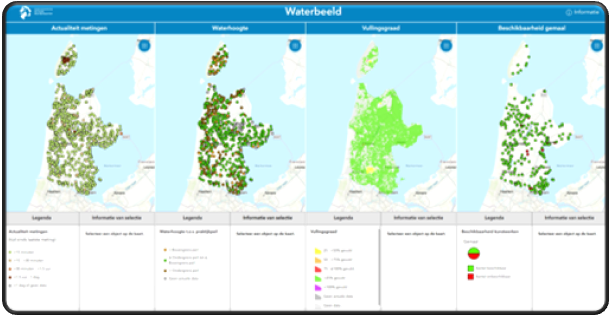
To be better prepared for flooding, HHNK, in collaboration with Delft University of Technology, has developed “Waterbeeld” as part of the FlashFloodBreaker project. This is a digital application that continuously collects information from thousands of sensors throughout the management area. Among other things, these sensors measure water levels in canals, ditches, and waterways. Waterbeeld automatically processes this data and displays how high the water is and how full an area is. This provides staff with an up-to-date and reliable overview of the situation under normal conditions as well as available storage capacity in the event of impending flooding. The information is displayed 24/7 on a screen in the emergency operations center. With this information, developments can be monitored more quickly, and better-informed decisions can be made regarding the management of the water system and during crisis decision-making.