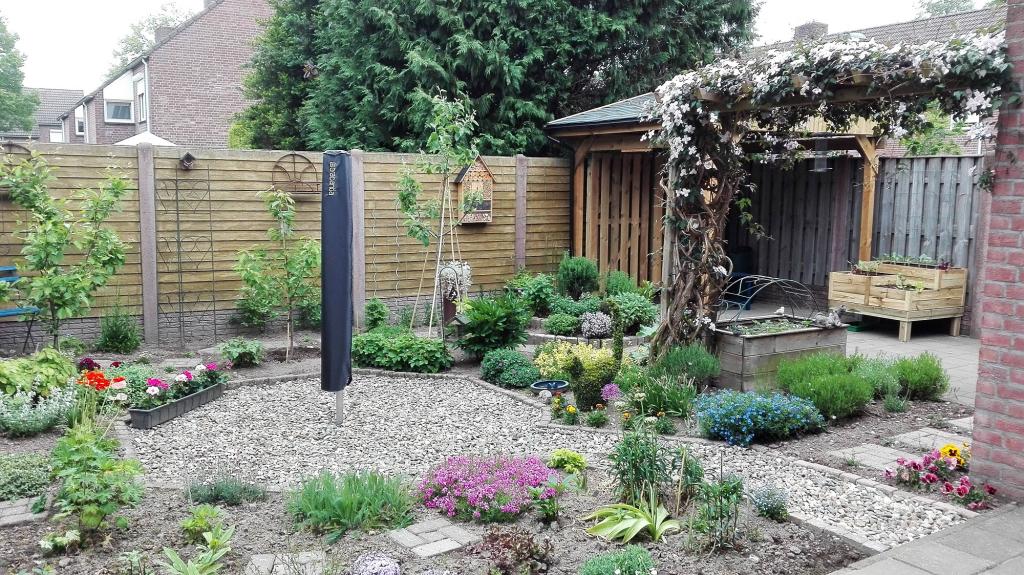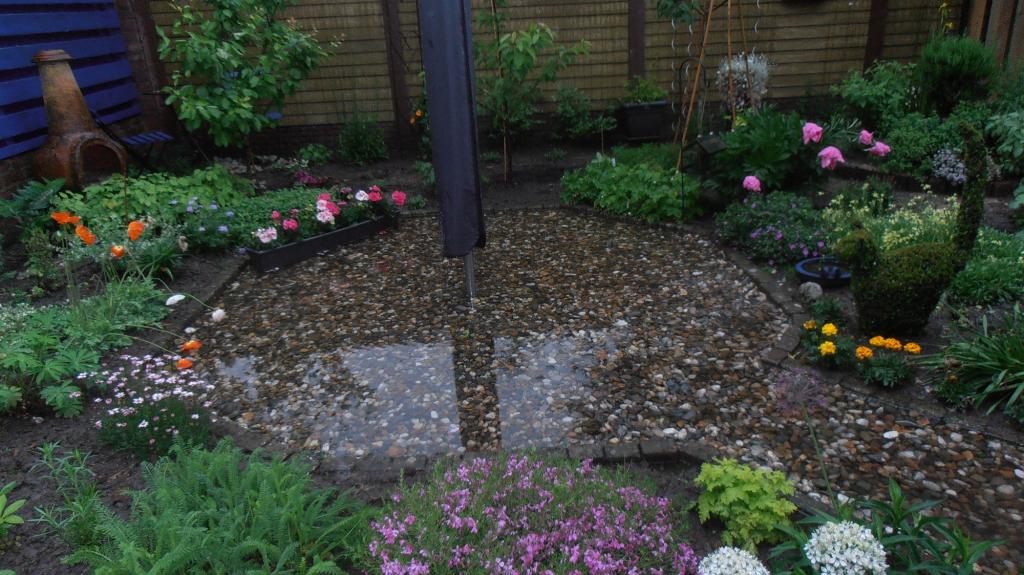
Gravel terrace
Most people install paving in their gardens for a variety of reasons. For an attractive green garden, the rule of thumb is that you should not pave more than 40% of your garden. The rest of the garden should then be reserved for greenery.
It is best to install water-permeable paving such as gravel or wood chips. Rainwater that falls on the gravel or wood chips can easily sink into the ground. If you install the water-permeable paving lower than the rest of your garden, you can also collect rainwater from your roof there. With well-permeable paving, rainwater from almost all showers sinks directly into the soil. Only during heavy peak showers does water remain standing for a short time. Practical experience shows that this is not a problem.
Costs
The construction of permeable paving is almost never more expensive than impermeable paving. In fact, with impermeable paving, you have to install facilities for the drainage of rainwater.
Use of space
In terms of space utilization, it makes no difference whether you use permeable or impermeable paving.
Difficulty
Laying paving requires some skill. It is a good idea to lay an infiltration fabric under the gravel or wood chips. This keeps the material well separated from the subsoil while still allowing the paving to drain properly. Anti-root fabric makes it more difficult for water to pass through.
Earthmoving
Most gardens are flat. If this is the case, you will need to excavate the area where the paving will be laid. Most types of paving need to be laid on a sand bed. Are you using gravel or wood chip paving? Then a sand bed is usually not necessary and less groundwork needs to be done. The garden must be low enough in relation to your home to prevent nuisance during heavy rainfall. This will prevent water from entering the house during a heavy downpour. If your garden is not low enough, you will need to remove the excess soil.
Maintenance
Permeable paving requires the same maintenance as other types of paving. Wood chips usually need to be replenished every year. With most types of paving, it is necessary to remove weeds a few times a year.
Climate goals
Paving does not contribute to increasing biodiversity or combating heat stress. That is why it is important to keep sufficient greenery in the garden. Water-permeable paving is ideal for collecting rainwater and allowing it to sink into the soil. In the backyard shown in the photos below, gravel paving was laid in the past for the rotary clothes dryer. The garden slopes down to this gravel terrace on all sides and is approximately 20 centimeters lower than the floor level of the house. The subsoil is highly permeable. The paving consists of a layer of approximately 5 cm of gravel. The gravel terrace not only collects rainwater from the entire backyard, but also from 60m² of the roof at the rear of the house.