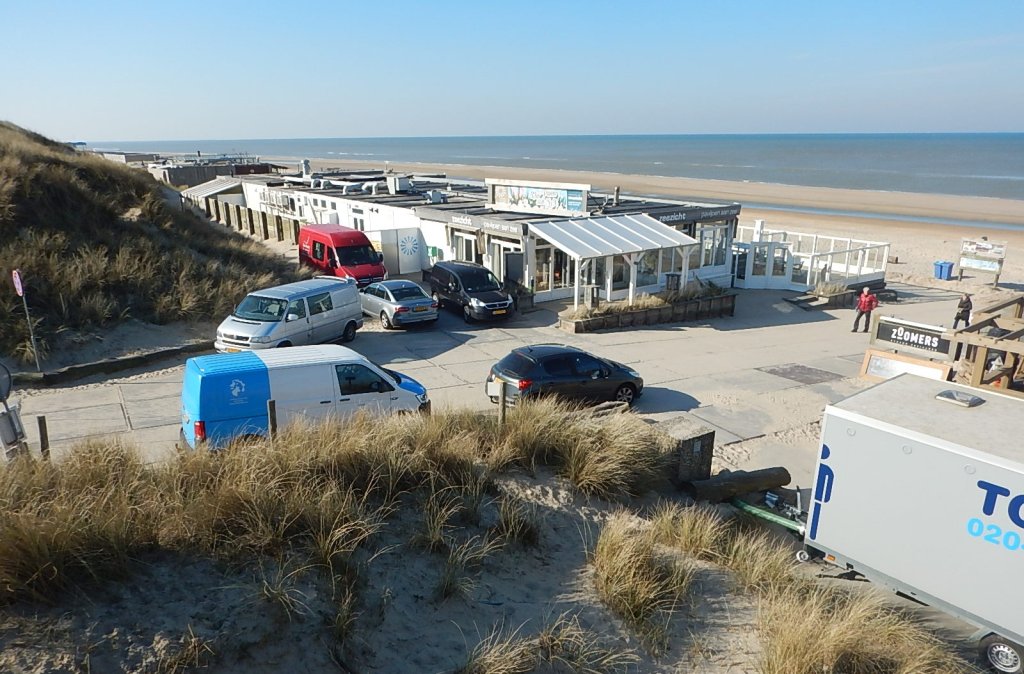
HHNK Expands Policy for Year-Round Pavilions in Castricum aan Zee
We are granting the beach pavilions in Castricum aan Zee authorisation permission to remain in place year-round. This is the conclusion of a study we conducted to provide clarity and arrive at a structural solution. A key principle is that water safety must remain guaranteed. The dunes protect the inland area from flooding. Beach pavilions must not hinder dune growth. Thanks to favorable local conditions and current laws and regulations, HHNK can allow the pavilions to remain in place year-round.
Arnold Langeveld, water board member at HHNK: “As a standard, we apply a distance requirement of 150 metre between year-round beach pavilions, but the coastline near Castricum is exceptionally robust, with wide and high dunes. We therefore conducted a pilot study to assess the effects of the short distances between pavilions on dynamic coastal management and water safety. Discussions were held with, among others, pavilion operators, the municipality, and nature organizations. We are pleased to now be able to provide some certainty to the beach operators and the municipality of Castricum.”
Customization available
The beach pavilions Deining/Sports at Sea, Zoomers, Zeezicht, and Club Zand can apply for their “ licence ” for a ten-year period starting in 2030. Langeveld: “Customized solutions are possible here, partly due to current laws and regulations. Even with rising sea levels, this seawall will remain safe—despite the pavilions being located there. We can therefore grant permits for the pavilions until at least 2040.”
Alderman Ivor Balke, who oversees beach affairs, is pleased with the vision outlined by HHNK. “As a municipality, we are currently working on a new beach policy. Business certainty and high-quality beach development are key building blocks for ensuring that Castricum’s beach can continue to develop in the coming years into an attractive beach of highly regarded quality. The vision outlined by HHNK is a key prerequisite for the municipality to work together with business owners and other stakeholders to create a beach where quality is a top priority.”
Sea-Level Rise
The dunes must remain high and wide enough to continue to provide protection against flooding as sea levels rise. As a water management agency, HHNK is responsible for water safety in the management area stretching from the North Sea Canal to Texel.
Rijkswaterstaat uses sand replenishment to promote the growth of dunes along the Dutch coast. To do this, large dredgers on a ship extract sand from the North Sea and deposit it just offshore or on the coast. The deposited sand reinforces the beach and the dunes. Some of the deposited sand is blown into the dunes, causing them to grow further.
Beach pavilions and dune growth
Beach pavilions can hinder dune growth. Over time, this jeopardizes water safety. For this reason, pavilions cannot always remain in place. HHNK issues permits to pavilion owners and enforces regulations to ensure a safe hinterland. In Castricum, the pavilions do not pose a risk to water safety. The dunes there are already wide and high enough. Because of the existing wide and high dunes, HHNK is able to facilitate and issue permits for the pavilions (and thus beach recreation).