
Unstable or not? Calculating from drained to undrained conditions
When assessing a dike, one of the factors considered is its stability. There are often reasons to doubt the results, as was the case with the Overleek embankment. Is this really correct, we wondered. We decided to recalculate, but using a different method: undrained analysis. This led to a pilot project. Geotechnical consultants Thijs Zonneveld and Mitchell van der Horst discuss the study and the results, on which the final word has not yet been spoken.
When assessing a regional flood barrier, we determine its strength based on drained behaviour. What does that mean?
Thijs: “This is a stability analysis based on a ‘drained condition,’ in which excess pressures in the groundwater level can dissipate effectively. This condition occurs under regular, extensive loads, such as through traffic and a stable surface water level. Regional floodgates are, by definition, floodgates with a drained situation; traffic is usually not heavy, and the extremes of the reservoir level are a few decimeters above or below the average level.”
When assessing the embankment at Overleek, you decided to perform another calculation after the drained calculation. Why?
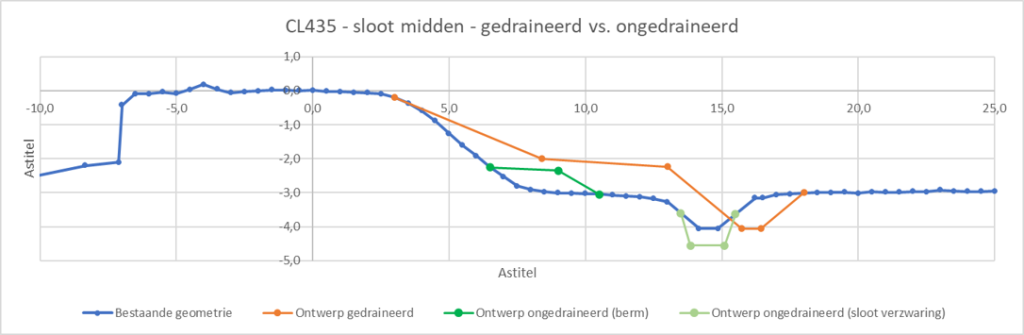
Thijs: “The calculation showed that the embankment was unstable. It would need to be significantly widened in several places to remain stable in a drained condition. We would have to make major changes to the area (longer slope, relocation of the shoulder, relocation of the toe ditch, stability screen), which would have consequences not only for the surrounding area but also for HHNK’s budget. We asked ourselves: is such an investment really necessary? Is the embankment really that unstable in its current state? That’s why we decided to run another calculation on it—an undrained one.”
Mitchell: “For the past few years, we’ve had software that makes undrained computation easier.”
What are the differences between drained and undrained calculations?
Thijs: “The difference lies in the basic premise. In an undrained situation, excess pressures in the groundwater level cannot dissipate properly. These excess pressures typically arise in poorly permeable soil layers as a result of something heavy exerting prolonged pressure on the dike, such as an elevated drainage basin level or a parked truck. These are conditions that occur less frequently than those in drained calculations.”
Mitchell: “For a long time, there has been a perception that the current method of drained design, in specific situations, does not fully reflect reality or the loads we input into the design model. The standard requires us to assume high traffic loads, which leads to water saturation in the subsoil. At the same time, soil strength is determined under conditions without water saturation. With undrained calculations, we use new techniques to determine soil strength under conditions that better reflect reality.”

How did you handle it?
Thijs: “We did that through soil testing. We drilled at various points along the dike. The samples were then analyzed in the lab.”
Mitchell: “We have identified two scenarios:
- A situation involving high water levels in the retention basin, heavy traffic, and high groundwater levels due to heavy rainfall. These are "design conditions." The calculation is based on undrained conditions.
- A typical daily scenario with normal water levels in the reservoir and no traffic load. In this scenario, we were essentially examining the deformation of the dike under its own weight. For this, we used the traditional “drained” calculation method.”
Were there any obstacles?
Thijs: “There were several obstacles. First, we had to develop a methodology for regional flood defenses, because none existed. We actually only use undrained calculations for primary flood defenses. In addition, we needed to justify conducting soil investigations, because they are very expensive.”
What are the results?
Thijs: “We analyzed both the design conditions and the everyday conditions. And what did we find? The embankment at Overleek is stable in a design situation at several locations, whereas it is not stable in an everyday drained situation. This is striking.”
Because the dike appears stable, the results have been called into question under normal conditions. A pilot project conducted with Survintel investigated whether InSAR data can provide a basis for a management decision. InSAR data provide insight into the deformation of the subsurface. The goal of the pilot was to investigate whether InSAR data provide sufficient information to rule out excessive deformation of the dike, thereby making approval based on proven strength for the daily situation possible after all. Monitoring was conducted to verify the results of Survintel.”
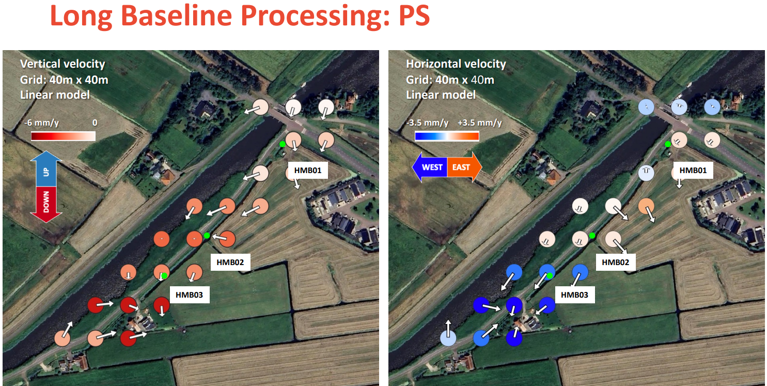
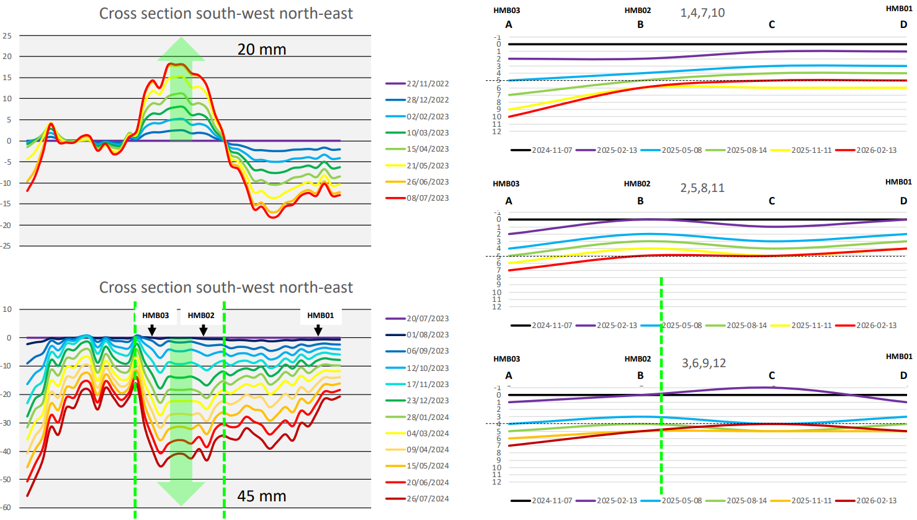
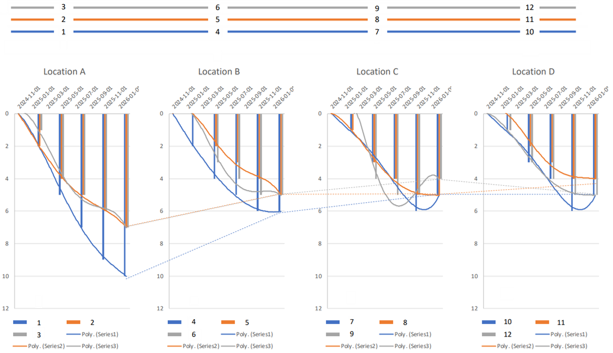
The monitoring data is reasonably consistent with Survintel’s analysis. The measured horizontal deformation is too large to state with certainty that the dike is sufficiently stable under normal conditions. The deviating results suggest that plastic deformation is occurring. Therefore, it was decided to reinforce all sections. Nevertheless, there is a benefit: partly due to the application of the undrained calculation method, the reinforcement is limited to reinforcing the toe ditch bottom.”
In what other situations would undrained calculation be an option?
Thijs: “This is an option for flood defenses with a similar soil structure. One of the basic principles of undrained design is that water has difficulty draining away. Soil types such as peat and clay impede the flow of water. We have many dikes built on peat or clay soil, especially in the southern part of our region.”
Mitchell: “Soils with good drainage, such as sand and sandy clay, do not become waterlogged under peak loads.”
What is needed to successfully integrate undrained calculations?
Mitchell: “We need support from other water boards to adopt undrained design as the standard method. Some questions remain from the pilot, particularly regarding how we account for the strength of the dike in the normal, drained conditions. We have shared the results with STOWA. This topic is now being addressed on a national level. In my opinion, undrained design calculations are not a replacement for the standard assessment method, because they are not viable for all soil types and are also a costly exercise. However, they are a very promising tool for further investigation to ensure that reinforcement is truly necessary.”
Rens Stam