Memorandum of Understanding on Reducing Pharmaceutical Residues in Wastewater
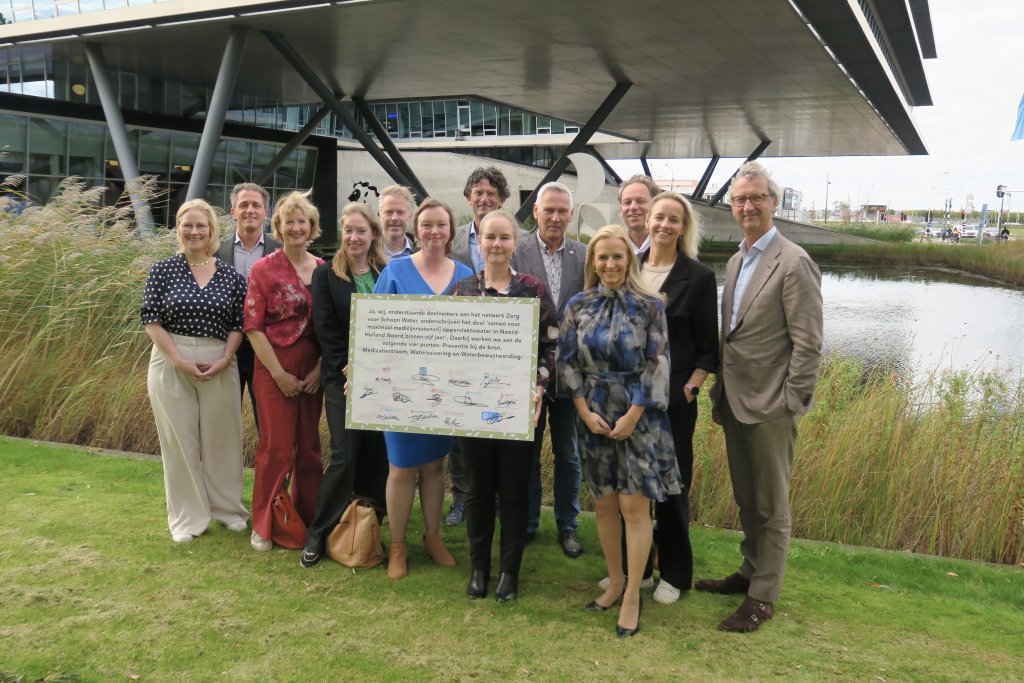
Medication residues do not belong in surface water. That is why healthcare organizations, an insurance company, and the Hollands Noorderkwartier Water Board (HHNK) are joining forces. On Thursday, October 15, they signed a joint letter of intent to reduce the amount of medication residues in the water in the coming years.
People who take medication usually do not consciously flush the leftover medication down the toilet. Nevertheless, medication residues eventually end up in surface water via the sewer system. This is because current wastewater treatment plants are not designed to remove all medication residues from wastewater. Each year in the Netherlands, an estimated 190,000 kilograms of medication residues enter the environment via wastewater.
The participating organizations believe this needs to change. “Medication residues in the water are a growing challenge that no single organization can solve on its own,” says Water Board Member Marjan Leijen. “That’s why I’m proud that so many parties from the healthcare sector are signing on today. It is precisely by working together—from prescribers to water managers—that we can reduce the amount of medication residues and better protect our natural environment. Ultimately, we want to prevent these substances from entering the water. Where that isn’t possible, we’ll have to invest in additional treatment.”
Not just cleaning the water, but preventing contamination
The parties do not want to focus solely on what happens at the wastewater treatment plant. The approach begins earlier in the chain: with the prescribing and use of medications, the disposal of unused medications, and raising awareness among healthcare professionals and residents.
The collaboration therefore focuses on four areas: prevention at the source, improving the flow of medications and the collection of unused medications, further development of water treatment, and raising awareness.
To that end, the regional network NHN Care for Clean Water is being established. Healthcare organizations, the VGZ Cooperative, and HHNK will share knowledge, carry out projects, and monitor the results through this network.
From the hospital to the family doctor
Various types of healthcare organizations are participating in the collaboration, including hospitals, primary care organizations, healthcare facilities, and a health insurer. This allows measures to be directly linked to daily healthcare practice.
The memorandum of understanding will be signed by APCON, Magentazorg, Omring, Noordwest Ziekenhuisgroep, Rode Kruis Ziekenhuis, Dijklander Ziekenhuis, GGZ Noord-Holland Noord, HKN Huisartsen, CAWF, Amsterdam UMC, Coöperatie VGZ, HWF, and HHNK.
The organizers hope that more organizations will join the regional network. The ultimate goal is clear: to minimize the amount of pharmaceutical residues in the surface water of North Holland North.