
Q&A on the Water Main Break in Amsterdam-Noord
Situation
What happened?
On the night of August 30, at around 2:00 a.m., a large Waternet wastewater pressure pipeline ruptured near Schellingwoude. As a result, approximately 36,000 m³ of municipal wastewater (consisting of 16,000 m³ of wastewater and 20,000 m³ of rainwater) entered the surface water system. This led to a sharp drop in the oxygen content of the water, causing, among other things, fish mortality.
What is the contaminated area?
- Amsterdam North
- Zunderdorp
- Ransdorp
- Monnickendam / Waterland
The contaminated area includes parts of Amsterdam-Noord and the surrounding rural areas where the effects of the pressure pipe rupture are noticeable. Due to precipitation and the flow of the water system, the contaminated and diluted water has spread through Zunderdorp, Ransdorp, and toward Monnickendam, among other places.
This has also affected the municipality of Waterland. The area around Monnickendam is part of the region where measures are being taken and where water quality is being monitored.
Because the situation is evolving and water quality varies by location, the area is continuously monitored.
What is the current situation?
The situation is improving. Measurements show that oxygen levels are recovering at several locations, and there have been no new reports of fish deaths. At the same time, there are local variations in water quality. Therefore, monitoring and precautionary measures remain necessary.
Why was the initial estimate two to three days, when recovery is now taking longer?
That assessment concerned the expected discharge of contaminated water from parts of the water system. It did not pertain to the repair of the pressure pipeline itself. Moreover, it later became apparent that both the extent of the contamination and the affected area were larger than initially assumed.
Why have some areas been hit harder than others?
The water system consists of many different ditches and waterways that vary in flow rate, water depth, and flow direction. As a result, the effects can vary greatly from place to place.
Noticeable effects in the area
Why do I see grey water or brownish-black flakes in the water?
The discharge of wastewater has caused contaminated particles and sediment to become visible. In addition, dark flakes may form due to oxygen depletion and natural decomposition processes. At many locations, these phenomena are now subsiding. In some places, small pieces of peat are floating to the surface due to gas formation.
If you notice water grey , floating flakes, or other unusual phenomena in the water, please continue to report them so that we can keep monitoring the situation. It is important that you provide the location as accurately as possible. Reports can be submitted during office hours (8:00 a.m. – 5:00 p.m.) by calling 072-582-82-82 and outside office hours by calling 0800-1430.
Why does the water smell different than usual?
The discharge of sewage has introduced additional nutrients into the water. This triggers various natural processes in the water. Among other things, these processes can produce a gas that smells like rotten eggs. As a result, this odor may be noticeable in the area for a short time.
Why did so many fish die?
The fish die-off was caused by a lack of oxygen. This was the result of a combination of hot weather, naturally low oxygen levels in the water system, and the large amount of nutrients from wastewater. As a result, microorganisms consumed virtually all the available oxygen in the water.
Are fish still dying?
At this time, no new reports of dead fish or fish in distress have been received. However, the situation is being actively monitored. If you see dead fish or fish gasping for air at the water’s surface, please call us during office hours (8:00 a.m.–5:00 p.m.) at 072-582-82-82 and after hours at 0800-1430. Please provide the specific location where you saw these fish.
When did you start removing the dead fish?
HHNK and Waternet jointly began removing the dead fish on Wednesday, September 2. In the days leading up to that, the extent of the pollution was not yet fully clear. Based on reports of dead fish and the measurements taken, it became clear on Monday, August 31, and Tuesday, September 1, that the situation was more serious and widespread than initially assumed.
Why weren't the dead fish removed sooner?
In hindsight, the cleanup of the dead fish could have been started sooner. Initially, it was expected that the wastewater would be significantly diluted by the heavy rainfall and that the consequences would be limited. It later turned out that the extent of the pollution was greater than anticipated. This point will be included in the evaluation.
How many kilograms of dead fish have been collected so far?
No exact figures are available on this. The effort was focused on removing dead fish as quickly as possible and limiting further negative effects on the aquatic ecosystem.
Using the Water
Can I swim or go boating in the affected area?
Due to a break in the pressure pipe, sewage has entered the surface water. Therefore, the recommendation is not to use the surface water in the affected area.
Can I swim in places where the contaminated water has been discharged, such as the Markermeer?
It is always a good idea to check the current swimming advisory for a particular swimming location. The province is responsible for ensuring the safety of swimming waters and, based on the water quality data it receives, may issue a negative swimming advisory or a swimming ban for official open-water swimming locations. For more information, visit www.zwemwater.nl
What are the risks of coming into contact with the water?
To do so, please contact the GGD.
What should I do if I've come into contact with the water?
In that case, follow the usual hygiene measures: rinse your skin or the materials with clean water and soap, and watch for any health symptoms. If you experience any health symptoms, contact your family doctor.
How long is the recommendation in effect?
The advisory will remain in effect until measurements show that water quality has sufficiently recovered. As soon as more information is available, it will be published at www.hhnk.nl/persleidingbreuk.
Is it possible to put up warning signs in the area?
The placement of warning signs is being evaluated in consultation with the GGD.
Animals
Can my (pet) drink from the water?
Surface water poses risks. Its quality can change rapidly due to hot weather (such as blue-green algae or bacteria) or due to discharges. HHNK and the Union of Water Boards generally advise against using untreated surface water as a water source for animals, because, unfortunately, the water quality is generally poor. The introduction of large quantities of municipal wastewater into a water system—such as that caused by this pressure pipe rupture—reinforces this recommendation.
What if my pet has already drunk water from the water source?
If your pet is showing signs of illness, we recommend that you consult a veterinarian.
Is the water safe for livestock?
Surface water poses risks. Its quality can change rapidly due to hot weather (such as blue-green algae or bacteria) or due to discharges. HHNK and the Union of Water Boards generally advise against using untreated surface water as a water source for animals, because, unfortunately, the water quality is generally poor. The introduction of large quantities of municipal wastewater into a water system—such as that caused by this pressure pipe rupture—reinforces this recommendation.
We fully understand that information is being requested at the local level. The sampling results are being analyzed, but we are asking GD-Diergezondheid—a Dutch company based in Deventer that is dedicated to the health of farm animals and companion animals—to assess whether there are any restrictions on livestock grazing. We adopted this suggestion based on feedback received during the residents’ meeting on September 10.
Agriculture
Can I use water from the ditch for watering?
Surface water may naturally contain contaminants and may therefore pose risks. Water quality can vary due to factors such as weather conditions, runoff, bacteria, algae, or other contaminants. For this reason, we generally recommend exercising caution when using untreated surface water for irrigation.
In addition, a large amount of municipal wastewater entered the water system as a result of the pressure pipe rupture. Therefore, it is not recommended to use surface water from the affected area.
I watered my vegetables with the contaminated water. Can I still eat them?
According to the GGD, food products that have been sprayed with contaminated surface water may have become contaminated. The recommendation is to wash fruits and vegetables thoroughly, peel them when possible, and cook them thoroughly before eating. These are general hygiene measures that also apply to the regular use of surface water, since surface water can naturally contain contaminants.
What alternatives are there to irrigation?
Rainwater is the very best, so we always recommend it.
Maintenance of Waterways
Can I dredge?
No, the current recommendation is not to dredge ditches in the affected area. This also applies to cleaning the ditches. First, it must be determined whether and to what extent the waterbed has been contaminated as a result of the pressure pipe rupture. Investigations into this matter are still ongoing. More clarity on this issue is expected by the end of September.
Until that clarity is established, we recommend that no dredging operations be carried out in the affected area. As soon as the results of the investigation are available and the recommendation is updated, we will provide an update via hhnk.nl/persleidingbreuk.
Can I mow the lawn?
Yes. Mowing and cleaning ditches through dredging are two different activities. Mowing can continue. As for cleaning ditches, the current recommendation is to wait until there is more clarity regarding any contamination of the riverbed.
I received a letter about the fall inspection. Do I need to clean my drains?
No, the recommendation is not to clean the ditches in the affected area. First, we need clarity regarding any potential contamination in the soil. We expect to be able to provide clarity on this by the end of September. The inspection has been postponed. You may disregard the letter regarding the fall inspection for now. When the above recommendation is lifted, we will provide an update via www.hhnk.nl/persleidingbreuk.
Measures and Recovery
What measures have been taken since the pipe burst?
A diversion route was immediately set up to divert wastewater. In addition, measures taken included installing aerators, using pumps to supply cleaner water, draining contaminated water, removing dead fish, and conducting additional water quality tests.
What are you doing to prevent further fish deaths?
To increase the oxygen content in the water, aeration pumps have been installed at several strategic locations. In addition, extra pumps are being used to bring in cleaner water and further dilute the contaminated water.
Where is the contaminated water discharged?
The peak pollution was discharged via the Kadoelen pumping station. Now, the water is discharged via the Kadoelen pumping station into the North Sea Canal or via the De Poel pumping station into Lake Markermeer.
Has the pressure line been repaired yet?
No. Waternet is working on the repair. It is expected to take at least two weeks.
Why does recovery take at least two weeks?
Repairing a pressure pipeline of this size is technically complex. Waternet is working day and night on the repairs. At the same time, wastewater discharge must continue to be ensured via a temporary diversion route. For this reason, the repairs are expected to take at least two weeks.
Is there still a danger to the surrounding area from the pipe break itself?
At this time, there is no danger to the surrounding area from the pressure pipe.
What will happen if there's a lot of rain again?
Various scenarios have been developed to address changes in weather conditions. The organizations involved are closely monitoring the situation and will take additional measures as necessary.
Water Quality and Monitoring
What measurements are taken?
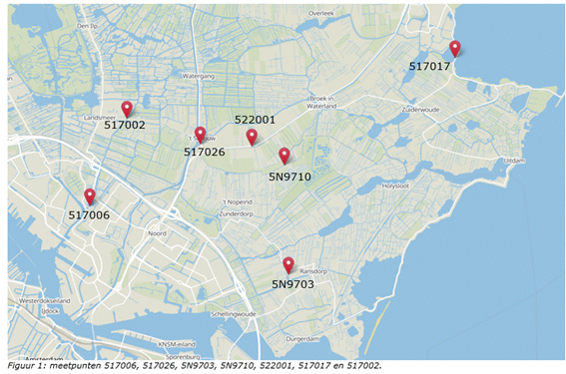
Water quality has been monitored at fixed monitoring points in the area for many years. The attached map shows these monitoring points. Due to the pipe break, samples are being collected at these fixed monitoring points in the area to determine the impact of the break. This allows us not only to assess the current situation but also to compare it with previous monitoring data from the area.
Are the measurement results public?
As soon as all the measurements have been received and analyzed, the results will be made public.
When will the test results be available?
The additional sampling began on September 7, 2026. Initial results are expected during the week of September 21–25, 2026.
How long will you continue to take measurements?
We will continue to monitor the oxygen levels until they stabilize and reach the correct level.
Which organizations are involved in the measurements?
Sampling is performed by an accredited laboratory with expertise in aquatic sediments and surface water.
Are the effects on nature and ecology also being considered?
Yes, ecological impacts are part of the monitoring process. An ecologist is involved in the study. It is still too early to draw conclusions.
Are they also investigating which substances have ended up in the water?
Water quality testing is intended to provide insight into the presence of substances that have entered the water system via municipal wastewater. The final results are not yet available.
Is the seabed being surveyed?
An investigation has been commissioned to assess the quality of the riverbed. In addition, samples are being collected at existing WFD monitoring sites to assess the impact of the pressure pipeline rupture on water quality and the riverbed. The results will be used to identify any potential impacts and determine whether additional measures are needed.
Will contaminated sludge or any contaminated waterbed be cleaned up?
That is not yet known at this time. A study has been commissioned to assess the quality of the riverbed. Sampling is taking place primarily in the vicinity of the pressure pipe rupture and is being conducted by an external firm.
If the investigation reveals that the waterbed has been contaminated as a result of the pressure pipe rupture, HHNK will hold the party responsible—in this case, Waternet—accountable for cleaning up the contamination. The necessary measures will be determined based on the results of the investigation.
Cause and Evaluation
What caused the pressure pipe rupture?
The cause is not yet known. Waternet is investigating the cause of the pipe break. The results will be made public at a later date.
Why did it take about five hours to shut off the pipe?
This is part of the evaluation. Waternet is investigating whether the pipeline could have been shut off more quickly and what lessons can be learned for the future.
Why was the contaminated water able to spread so far?
The spread of the contaminated water was caused by a combination of factors. After the pressure pipe ruptured, a large volume of wastewater entered a vast and complex water system, in which water levels, flow directions, and discharge capacity vary by area.
Initially, the decision was made to discharge the contaminated water via the Kadoelen pumping station toward the North Sea Canal. The wind was favorable for this. The Kadoelen pumping station was activated, and the De Poel pumping station was deactivated. At that time, it was expected that the wastewater had been significantly diluted by the heavy rainfall and that the impact on the water system would be limited. Furthermore, damming off such a large volume of contaminated surface water is not feasible, and the water had already penetrated further into the system.
In the days that followed, the situation continued to develop. The wind shifted direction and picked up in strength. At that point, it was no longer possible to discharge the water via Kadoelen. The decision was made to discharge it via De Poel instead. We let water in at Kadoelen. There was a lot of rain, which helped dilute the contaminated water further.
Will the emergency be evaluated?
Yes. We want to commission an external investigation into how Waternet and HHNK handled the pipe break. That investigation will begin once we have completed the phase of implementing measures and making repairs. We expect that to be in November. We will define the scope of the investigation in consultation with the advisory group.
What is being done to prevent this from happening again?
That is part of the investigation and evaluation. Among other things, the investigation will examine the cause of the pipe break, the detection of incidents, and the response during the emergency.
Will the evaluation be made public?
Yes. The results of the evaluation will be shared via www.hhnk.nl/persleidingbreuk.
Will there be a focus group?
Yes. A focus group is being formed with residents and other stakeholders from the area to draw on local knowledge and contribute ideas regarding restoration, monitoring, and next steps. An invitation has already been sent to the focus group for an initial meeting.
Communication and Information Provision
How were residents and farmers informed about the water main break?
On August 30, communication regarding the broken water main began via social media (Facebook), followed by a live blog on the HHNK website. Initially, the focus was on a limited precautionary advisory: do not swim, fish, or let your pet swim in surface water. As more information became available about the extent of the contamination and the affected area, this advice was expanded to a general recommendation not to use surface water.
During the information session on September 10, HHNK and Waternet acknowledged that communication could have been better. We understand that there was a need for more information and quicker answers to specific questions, particularly from farmers and residents in the area. For this reason, additional questions and answers have been published, a residents’ meeting has been organized, and a focus group has been established to draw on local knowledge and involve stakeholders in the follow-up process and the restoration of the area.
How can I stay up to date on new developments?
We are sharing the latest updates regarding the water main break on our website www.hhnk.nl/persleidingbreuk
Where can I go with questions?
Through the contact form , you can submit your questions. We are available by phone on weekdays from 8:00 a.m. to 5:00 p.m. at our general phone number, 072 - 582 82 82.
Where can I report a claim?
If you have sustained damage as a result of the pressure pipe rupture, you can file a claim with HHNK. You can do so at www.hhnk.nl/een-schadeclaim-indienen. It is a good idea to explain the details of your claim and attach any supporting documentation or invoices.