
Improvement of the De Gors-Vurige Staart embankment
What's going to happen?
The assessment and reassessment showed that the embankment along the Oudelandsdijkje in Purmerend and the Molenpad near Ilpendam no longer meet the standard for inward stability. This means that the dike on the polder side is not strong enough and therefore needs to be improved. The dike improvement will also involve widening the current bicycle path. Combining both projects means that the environment will only be impacted once.
Where is the project taking place?
The section to be improved is located near the Gors neighborhood in Purmerend and runs along the Vurige Staart polder, ending at Ilpendam. The total length of the section is approximately 4 km.
Who do we work with?
The widening of the cycle path arose from a co-location opportunity proposed by the Amsterdam Transport Region. HHNK will work with this organization and the municipalities of Waterland and Purmerend to develop and implement the widening.
What will be done and how long will it take?
Dike improvement
Along the Oudelandsdijkje near the De Gors neighborhood, we are installing revetment on most of the dike side and adding clay to the inside of the dike. The dike slope will be slightly less steep. The dike will not be widened here and the dike ditch will not be relocated.
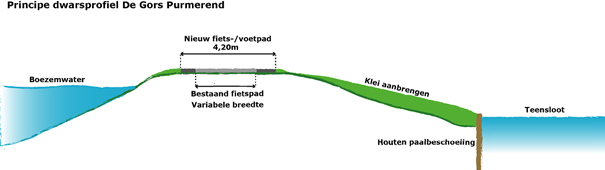
We are relocating the dike ditch at the Vurige Staart polder. The current ditch will be filled in. Clay will be applied to the embankment and the lower berm.

Afterwards, everything will be neatly reseeded with grass seed.
The work is largely carried out using electrical equipment.
Bicycle path
The current bike path is located on Oudelandsdijkje in the municipalities of Purmerend and Waterland. To make it more user-friendly and safer, HHNK is tackling the bike path in collaboration with both municipalities and the Amsterdam Transport Region.
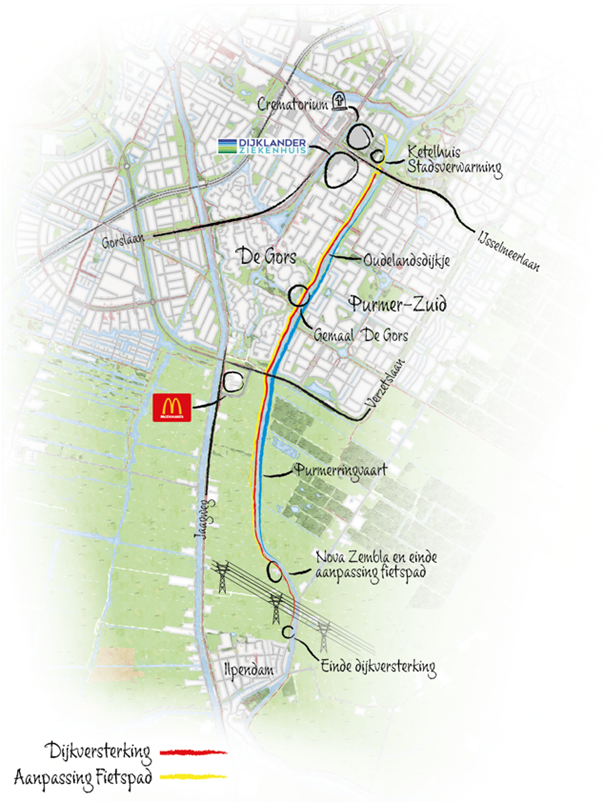
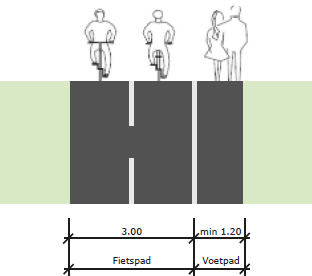
The current bike path will be widened from Oudelandsdijkje 3 Purmerend to Molenpad 8 Ilpendam (end of bike path) to 4.2 m wide and paved with black asphalt. This will bring the bike and footpath up to current standards and safety requirements. Lines painted on the black asphalt will separate the two sections.
The Oudelandsdijkje will be resurfaced with asphalt and new road markings from number 3 to the Purmerweg. The bike path will not be widened on this section.
Permits
Permits have been obtained for the dike improvement and widening of the bicycle/footpath.
Planning

The work will be carried out between October 2024 and September 2025. Work on the dike will take place first, followed by work on the cycle path/footpath.
Current changes to the schedule and implementation are tracked on this page and in the Bouwapp. You can download this app from the app store using the QR code. It allows you neighbourhood the construction projects in your neighbourhood .
Nuisance
During the construction period, local residents may experience some inconvenience. We will try to limit this as much as possible, but cannot eliminate it entirely. If there is a lot of dust, we will spray water to reduce it. Vibration meters will be installed on various homes on Oudelandsdijkje. As soon as vibrations exceed the limit values, work will be stopped.
The Oudelandsdijkje will be closed from IJsselmeerlaan Purmerend to Molenpad 8 Ilpendam from January to August 2025.
The section of Oudelandsdijkje from IJsselmeerlaan Purmerend to Purmerweg will be closed from the end of May until August 2025.
A diversion route will be set up. In mid-December 2024, the closure will be indicated in advance by means of signage. Residents on Oudelandsdijkje will be contacted to make arrangements regarding accessibility, parking, household waste, parcel delivery, etc.
Working hours are Monday through Friday from 7:00 a.m. to 5:00 p.m.
Contact details for further information
For more information about this project, please contact environmental manager Maarten Zon using thecontact formor by calling +31 (0)72 582 8282.
What policy underpins the project?
The water board is responsible for the dikes in North Holland. We regularly check whether the dikes are still safe. Due to climate change—it is raining harder and longer—the checks and requirements have been tightened. As a result, a large part of the dike around the polder no longer met the height and stability requirements. To keep our feet dry now and in the future, we are improving the dike where necessary. After the work is completed, the dike will be in good condition for the next 20 years.