
Swimming water
Official swimming locations
Together with the Waterproef Foundation laboratory, we ensure that the 31 official swimming locations in our waters are sampled monthly for swimming water parameters. These include blue-green algae, which can be toxic, and various bacteria, including E. coli. In addition, transparency, temperature, pH, etc. are measured. All these factors influence the quality of the swimming water.
The official swimming locations can be recognized by large blue signs at the outdoor swimming area and can also be found on the website www.zwemwater.nl. This website keeps track of what has been measured and the results of the measurements. It also contains reports on the swimming water location (if you click on the location, you will see a tab with measurement data on the right and a reference to the so-called swimming water profile at the bottom).
The province is the competent authority when it comes to bathing water. The province assesses the results of the measurements and determines whether a bathing location is safe enough or not. And it is the province that designates a location as a 'designated bathing location'. If a lot of people regularly swim at a particular location, then that location should be designated as a 'designated swimming location' (and investments should be made in management measures, such as marking out the swimming zone with a ball line), provided that the water quality is sufficient. Other functions of the water, such as shipping, are also taken into account.
If blue-green algae or bacteria exceed certain levels, we advise the province to issue a warning or negative swimming advice. We consult with the province and the manager of the swimming water (the recreation board or the municipality) to see if we can do anything about it. Sometimes this is fairly easy, but sometimes it has already been tried and has not worked or has not worked well enough. Of course, costs play a role here. If it is going to cost millions and only a few people go swimming, it is not worth it. Sometimes it works and the costs are manageable. And there is never a guarantee that we will never have problems again, because not everything in nature can be controlled.
Other swimming locations
Incidentally, the fact that the Netherlands has around 770 designated swimming locations does not mean that everyone who wants to swim outdoors does so at a designated swimming location. Many people swim in rivers, lakes, and ponds that are not designated for this purpose and where no explicit safety measures have been taken. In principle, swimming outside the official swimming locations is at your own risk. It is not always wise, but usually not prohibited (except near bridges and viaducts). We do not sample these locations for swimming water quality. We only make an exception for swimming events, such as City Swims.
Detailed information can be found in the report 'Swimming in surface water' (June 2020). This report by the Dutch Lifeguard Association explains how swimming in surface water is dealt with. The report focuses in particular on swimming safety and how this is regulated in the Netherlands. The project is part of the largerNL programme , which is coordinated by the National Swimming Safety Council and financially supported by the Ministry of Health, Welfare and Sport. The report focuses primarily on preventing drowning and less on preventing diseases caused by reduced water quality.


More information
More information can be found on the website of theInformation Point for the Living Environment.
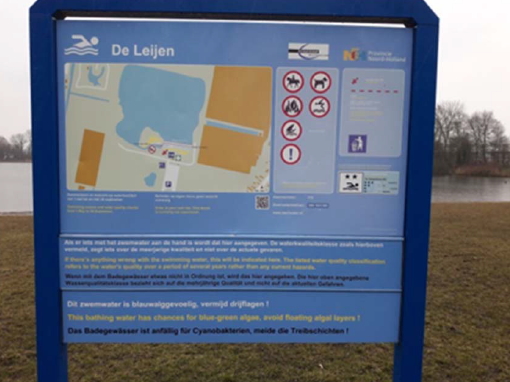
Blue sign at De Leijen swimming location