
Procurement procedures
With due observance of the principles set out in the Public Procurement Act and the Proportionality Guide, HHNK assesses which tendering procedure is appropriate and proportionate for each contract. The following factors are important in this regard:
- The type of contract being awarded. A distinction is made (among other things) between: public contracts for supplies and/or services, public contracts for social and other specific services, public contracts for works, service concession contracts, and works concession contracts.
- The estimated contract value of the contract in question. The color bars below show the tender thresholds applied by HHNK for each type of tender procedure. The European tender thresholds are based on the threshold values for European tenders that are set every two years by the European Commission and are in line with the principles of the Proportionality Guide. HHNK always applies the most recent European tender thresholds to its tenders. All amounts are exclusive of VAT.
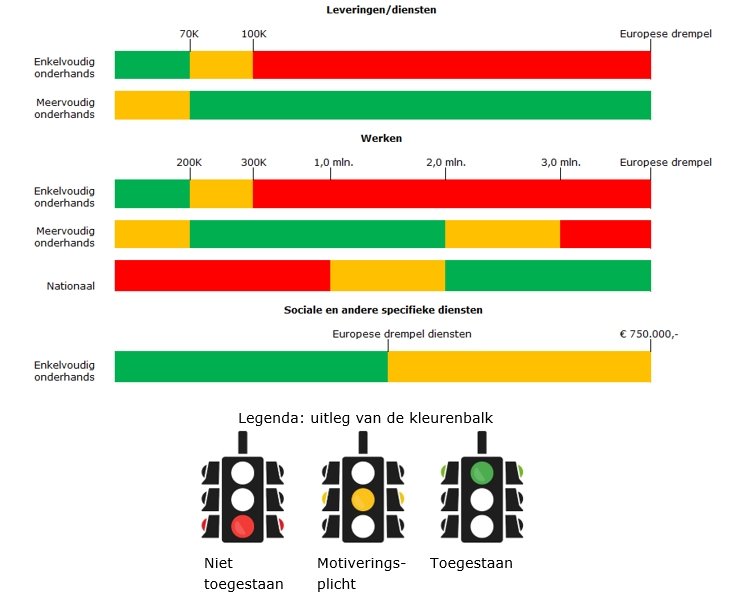
- Every proposed market approach for which a multiple private tender or a more rigorous procedure is mandatory must always first be submitted to the Market Advisory Team. (The MAT is an internal tender board at HHNK where every proposed market approach—with the exception of single contracts—is assessed against the procurement policy and policy principles.) To this end, the requester/project leader draws up a procurement plan in consultation with the permanent procurement advisor. If the estimated contract value falls within the orange area according to the color bar chart, the proposed tendering procedure must be properly justified.
- The European Commission revises the thresholds for European tenders every two years. HHNK always applies the current European tender thresholds in its tenders.
A tendering procedure is not mandatory in all cases; there are exceptions to the tendering obligation, both above and below the European thresholds. See Exceptions to the tendering obligation for more information.
Single private tender
HHNK approaches one company of its choice with the request for quotation.
Multiple private tendering
HHNK invites a limited number of companies, usually between three and five, to submit a tender. We select these companies based on a number of objective criteria. The contract is published onTenderNed, but is only accessible and visible to companies that we have approached for this tender.
National tendering
HHNK awards the contract to a company through a national procedure (public or non-public). An announcement of the contract is always published on TenderNed, which is only open to the Dutch market. This national procedure is similar to the European one but has shorter lead times.
European tendering
Above the European thresholds, HHNK must issue European tenders. These contracts are always published on TenderNed and are open to companies from all member states of the European Union (EU). Under certain conditions, they are also open to companies outside the EU (if they are affiliated with the EU through treaties). The most common procedures are the open and restricted procedures.
Requirements and preferences
Depending on the nature and scope of the assignment, requirements and criteria apply to our tenders.
Master List System
The master list system applies to (multiple) private tenders for engineering services and construction work.
According to HHNK’s procurement rules, engineering services with an estimated value of up to €70,000 (excluding VAT) may be awarded through a single-source procurement process, and a competitive procurement process may be used for contracts with an estimated value up to the current European threshold amount for supplies and services.
According to HHNK’s procurement rules, works with an estimated value of up to €200,000 (excluding VAT) may be awarded through a single-source procurement process, and works with an estimated value of up to €2,000,000 (excluding VAT) may be awarded through a competitive procurement process.
HHNK is free to deviate from the wholesale list system described here, provided it provides a justification for doing so.
Contracts for engineering services or works with an estimated value exceeding the current European thresholds are not included in this master list system. For those contracts, depending on the estimated contract value, an appropriate national or European procurement procedure will be issued via TenderNed.