BONSAI and Oeverdijk Hoorn
What's going to happen?
Boosting Flood Resilience in Estuarine Systems Anticipating Shifting Climate Zones
Bonsai originated from the group that collaborated on the Hedwige and Prosper polder. HHNK is participating in order to optimize our monitoring for both water safety (i.e., sand and water) and biodiversity. Here, other colleagues can learn from the lessons we have learned.
We observe and learn with like-minded individuals across national borders. It is both interesting and enjoyable! We are eager to share our findings with interested colleagues throughout this project.
The embankment is an innovative solution for a soft verge as a foreshore. This provides opportunities for nature and for simple climate-adaptive maintenance.
The Oeverdijk
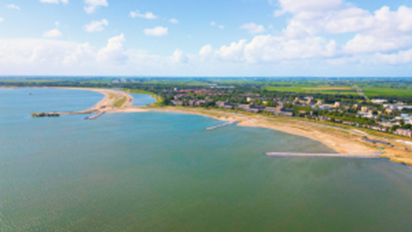
The Oeverdijk consists of a profile of sand that was constructed in front of the old dike. It completely takes over the function of water safety.
The required volume of sand for the safety profile must be available during the planning period (until 2071).
The Alliance has been tasked with designing a safe dike for the next 50 years. The administrator has stipulated that only regular maintenance is permitted.
For the Oeverdijk, this essentially means the desire to achieve a design that requires as little maintenance as possible, minimizing the risk of additional sand replenishment. For this reason, a wear layer has been incorporated into the design to enable the dynamic behaviour the embankment without directly affecting the total sand volume in the safety profile.
Reason for monitoring sand and water
At present, there is no clear-cut method for arriving at a realistic estimate of the volume of sand required in the wearing course. This is because insufficient knowledge is available about the dynamic behaviour a sandy foreshore in a lake situation. In order to be able to estimate the volume of sand, the shore dike was investigated using a model.
To this end, it is important to monitor the behaviour the embankment within the five-year project period and, if necessary, adjust the design. We are conducting this monitoring within the European Interreg project BONSAI. This means that the project has been awarded subsidies from Brussels and the Province of North Holland. Monitoring is crucial to understanding the behaviour the dike and ensuring water safety.
Who do we work with?
Bonsai is led by the Foundation for Applied Water Research (STOWA). Wecollaborate with 17 partners within the Netherlands and with partners from Belgium, France, and Germany, both from the field and from the research world.
Our practice partners in the field of flood risk management are:
- Netherlands: Rijkswaterstaat, HZ University of Applied Sciences, Ministry of Defense, Noorderzijlvest Water Authority, Radboud University;
- Belgium: Catholic University of Leuven, Université Catholique de Louvain, Department of Mobility and Public Works, De Vlaamse Waterweg, Institute for Nature and Forest Research;
- Germany: University of Siegen;
- France: University of Lille, CEREMA, ISL Engineering , ESTP – Grande école d’ingénieurs de la Construction.
When will the project take place and how long will it last?
The project officially started on January 1, 2025, and will run until June 30, 2029.
Results and goals
The main results are:
- a transnational strategy for national authorities and three action plans for regional and local authorities;
- Five solutions for increasing robustness and resilience and improving disaster management;
- multiple training programs and courses on flood disaster management and resilience, and one joint transnational flood academy.
Through a holistic approach, BONSAI aims to achieve resilience of the flood defense system (short/long term) and improved disaster management. Different NWE countries are tackling these challenges from their own perspective. Because estuarine systems and climate change transcend borders, transnational cooperation between NWE regions (and beyond) is essential. The BONSAI approach is unique:
- It bridges the three layers of multi-layer water safety: prevention, disaster management, and spatial planning.
- It simulates shifting climate zones by applying insights from southern regions to northern regions.
- It strengthens cooperation between countries to learn from each other, with the north learning from the south and the south learning from the north.
Budget
The total budget for the HHNK project is approximately €580,605.68, of which 60% is co-financed by the European programme North West Europe programme 2021-2027.
The total project budget amounts to €10,699,561.10, of which €6,419,736.62 comes from the European Regional Development Fund (ERDF).https://bonsai.nweurope.eu/
The Province of North Holland is co-financing the project and has made €87,091 available.