
Organization
Our board is responsible for policy. Hundreds of employees implement this policy. HHNK is a large employer, with approximately 900 FTEs and an annual budget of around €350 million. In addition to our head office in Heerhugowaard, we have various workshops and sewage treatment plants. Our organizational chart shows how HHNK's administrative organization is divided into departments.
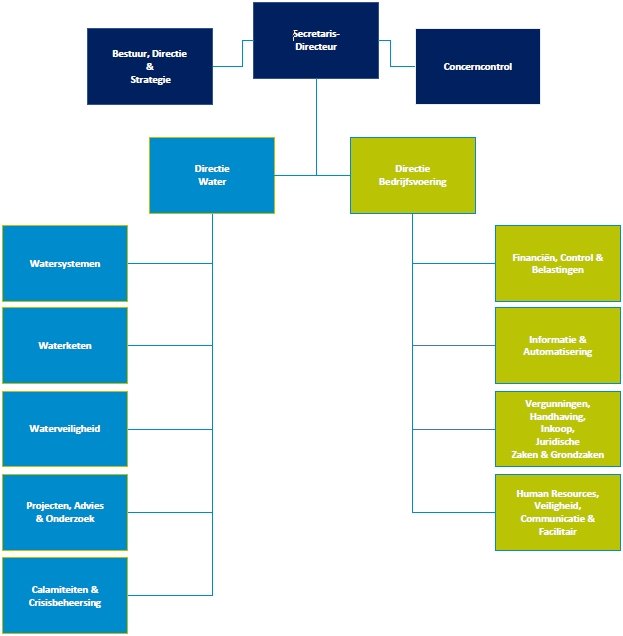
Our departments at a glance
Water systems
The Water Systems department ensures sufficient and clean surface water. The department is the 'owner' of our water systems, ditches, and canals with their weirs and pumping stations, and is responsible for water level management, the (re)design of the system, and measures to improve water quality and quantity. The employees take care of daily management, asset and relationship management, advise on water management, and contribute to necessary regional and national developments.
Water chain
The Water Chain department transports wastewater using 240 pumping stations via more than 500 km of pressure pipes, purifies it in 15 water treatment plants—a total of more than 100 million litre per year—and processes the remaining sludge, for example in fermentation plants to generate energy: we produce a lot of 'green' gas! The employees also provide electrical and mechanical maintenance for other departments.
Water safety
The Water Safety Department is responsible for area management, (water) safety, and the management and improvement of dykes, roads, bridges, and locks. In winter, it is responsible for gritting roads, implementing emergency plans in the event of imminent disasters, repairing faults, and responding to storm damage, accidents, and sudden water pollution.
Projects, Advice & Research
The Projects, Advice & Research department implements the water board's investment and major maintenance projects, including the dyke reinforcements from the Flood Protection Program. The employees engage engineering firms, contractors, and suppliers for this purpose and also prepare projects themselves. Projects to improve sewage treatment plants, wastewater transport systems, flood defenses, water storage facilities, roads, locks, weirs, bridges, pumping stations, watercourses, and dredging works are among the department's tasks. The department is also responsible for research and for contingency plans and coordination.
Emergencies & Crisis Management
The Emergency & Crisis Management department ensures that the organization is prepared for potential crisis situations. These could include a dike breach, a large-scale power outage, or severe flooding in our area. Employees from across the organization are on standby 24 hours a day, 7 days a week, to respond to crisis situations and emergencies. The Calamities and Crisis Management department is responsible for training these employees and organizing crisis exercises. The department ensures clear crisis plans are in place, identifies current risks that the organization may face, and maintains the network with external partners (such as safety regions). In short, the department is involved in all kinds of preparations to ensure that HHNK can act appropriately during a crisis.
Finance, Control & Taxation
The Finance, Control & Taxation department is responsible for the financial administration of the water board and related matters. For example, the department contributes to the preparation of the budget and takes care of the bookkeeping and the processing and payment of invoices. In addition, the department is responsible for the levying and collection of water board taxes.
Information & Automation
The Information & Automation department consists of the clusters ICT Management, Information Management, Data and Development, and Information Policy, Advice, and Projects. The department is responsible for all automation and information provision at HHNK.
Permits, Enforcement, Procurement, Legal Affairs & Land Affairs
The VHIJG department consists of three clusters: Permits, Enforcement, and Procurement, Legal Affairs & Land Affairs. The department's employees grant exemptions and permits, enforce legislation, provide legal advice, manage property rights, and take care of procurement and tenders for the water board.
Human Resources, Integrated Safety, Communication & Facilities
The HRVCF (Human Resources, Integral Safety, Communication & Facilities) department is a support department. The HR cluster is responsible for advice, service, and control in the areas of organizational policy and management, personnel policy and management, terms of employment, working conditions, and safety. The Integral Safety cluster deals with physical, social, and information security. The Communication cluster contributes to good, active internal and external communication with all stakeholders, including by actively involving target groups. The Facilities Cluster provides a wide range of support services, such as a Customer Contact Center and reception services, and everything related to accommodation and workplace support, including catering, cleaning, fleet management, meeting rooms, reprographic services, and courier services.
Group Control
The Group Control department is responsible for developing business frameworks, planning and control cycles, controlling and auditing, and the associated tools for the management. It advises the management on policy proposals that relate to the aforementioned areas.
Board, Management & Strategy
The BDS department supports the board and management in administrative and substantive matters, processes, and at a strategic level, enabling them to function optimally. The employees ensure streamlined meeting processes, assess the readiness of board proposals for decision-making, monitor actions, and promote strategy development in various areas, in close collaboration with the relevant departments. They also manage the relationship between HHNK and external organizations.