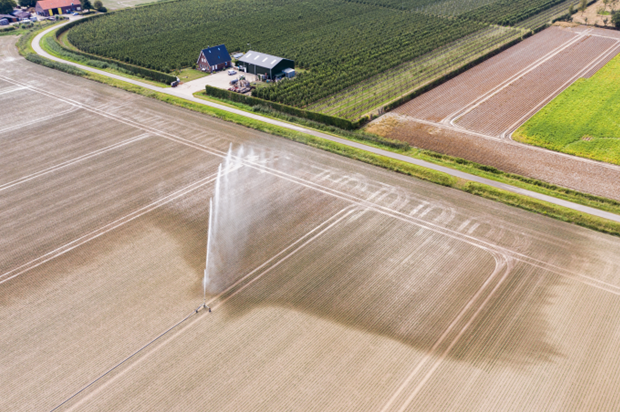
Start of the dry season: water districts ask gardeners for help
The dry season has begun. With the soil drier than usual, nature is under pressure, making it even more important to use our available water wisely in the coming months. New research* shows that 36% of Dutch people already collect rainwater, usually with a rain barrel. 40% do not yet do this but are considering it. It is precisely this latter group that the water authorities are now calling on to take action. The message to garden owners: do in your garden what the water authorities do on a large scale and retain water more effectively and for longer.
Drought in the Northern Quarter of Holland
In our management area (North Holland north of the North Sea Canal), the drought is not yet a cause for concern. The precipitation deficit is currently about 30 millimeters, which is above average for this time of year. At the same time, the forecast indicates that the last weeks of April, with the exception of two days, will be virtually dry. Drought could therefore have an impact in the coming weeks, but thanks to the water reserves in the IJsselmeer and Markermeer, the situation remains manageable for water management. In line with national policy, we have raised water levels in our polders and drainage basins where possible to maintain maximum freshwater reserves.
Let’s all use water more sparingly
According to the KNMI’s climate scenarios, droughts will become increasingly common in the future, meaning that water boards and Rijkswaterstaat will no longer be able to ensure a sufficient water supply everywhere and at all times. This means that everyone—industry, agriculture, government agencies, and residents—must use the available water more sparingly. Meanwhile, the water boards are working on a large scale to improve the resilience of regional water management. By raising water levels, restoring streams, retaining water longer, and focusing on healthy soils with better water retention capacity.
The Netherlands Takes Action to Collect Rainwater
More than a third of people in the Netherlands already collect rainwater. There is a strong willingness to contribute: 81% consider it important, and 71% are open to taking action themselves. Yet some people are still lagging behind, often because they don’t know what to do (18%) or don’t have the time or inclination to look into it (20%).
“Our new research shows that people are willing to take action, but there is a need for clear, achievable steps and a sense of urgency. That is why we launched the Watervangers campaign to demonstrate how easy it is to collect water in your garden. We hope to get that group moving and thereby contribute to the realization that every drop counts. If all private garden owners help collect and retain water, that will help us limit the disruption caused by water shortages,”saidJeroen Haan, chairman of the Union of Water Boards.
Do in your garden what the water authorities do on a large scale
Water authorities are urging homeowners to start using so-called “water collectors” themselves. “By collecting rainwater and using it later, for example in the garden, we reduce the burden on the sewer system and ensure water remains available longer during dry periods. While the rain barrel is by far the most popular option, a small wadi is the water collector with the greatest impact: you can collect as much as 100 to 1,000 litre in your garden,”saysWater Board Member Klazien Hartog.
For more tips on installing a rainwater collector in your garden, visitwww.watervangers.nl
* Source: Survey conducted in March 2026 by Blauw Research on behalf of the Union of Water Boards, regarding public knowledge and attitudes toward water boards and water use.