
The Noordermolen
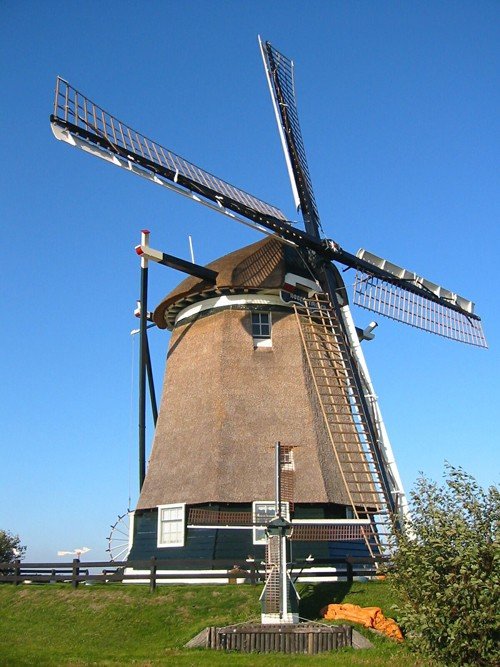
North of the Akersloot ferry, one of the most quintessentially Dutch sights dominates the horizon: the Noordermolen. The windmill is clearly visible from the A9, and even more so from the N244 just north of the Akersloot ferry. It is an old polder windmill that is also technically fascinating due to its unique screw mechanism.
The Noordermolen drains the Groot-Limmerpolder between Limmen and Akersloot. This polder took shape around 1500. Excess water was initially discharged into the Lange- or Alkmaardermeer via small locks. Due to land subsidence, this became increasingly difficult. By 1544, the polder had two mills to pump excess water into both the Alkmaardermeer and the Schermeer. These mills were burned to the ground during the Spanish advance into the region in 1573. On October 13, 1588, the States of Holland authorisation to levy a tax on the lands of Limmen, Akersloot, and Bakkum to build two new polder mills. Thus, the Noorder and Zuider mills were rebuilt around Akersloot.
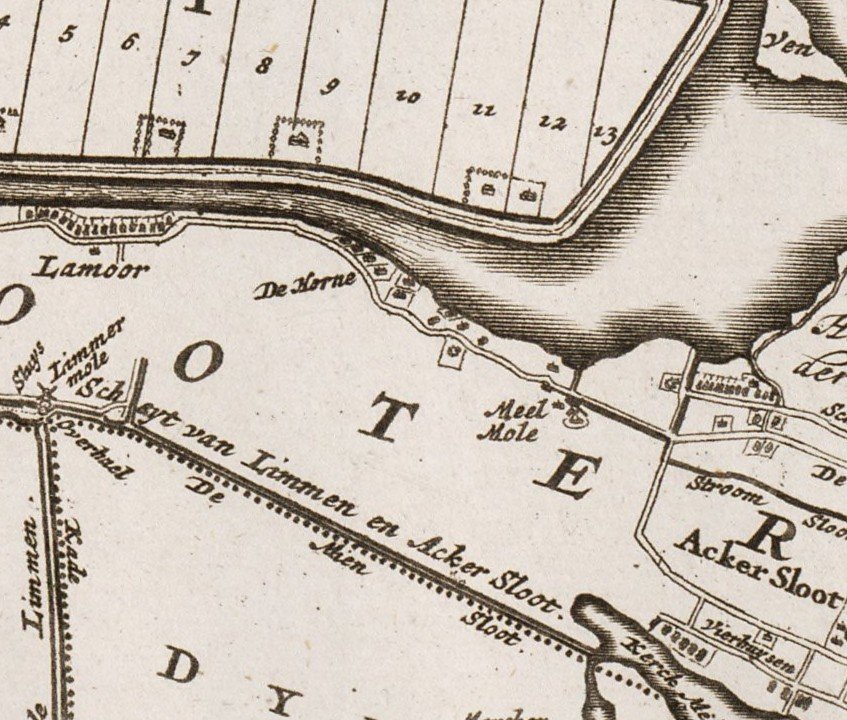
Wide screw
Although there was briefly talk in the mid-17th century of building a third mill in the Groot-Limmerpolder, the decision was ultimately made to stick with the original two. In 1861, the paddlewheel in the Noordermolen was replaced by a short but very wide screw pump, also known as a water screw. A commemorative plaque inside the mill still marks this event. At 2.56 metre , the screw’s diameter was metre even greater than its length. A screw pump was more efficient, and moreover, it was located beneath the mill rather than inside it, giving the miller more living space. In 1879, a 40-horsepower steam-powered screw pump station was also built in the polder on the site of the Zuidermolen. The steam installation was supplied by Stork of Hengelo for 11,930 guilders. The building housing the machinery was constructed by Reijer Klaas Koppen of West-Graftdijk and Guurtje Spaans of Akersloot for 13,497 guilders. Although the Zuidermolen was demolished, the screw pump remained in place. Thus, the steam engine powered the mill’s old screw pump, which helped reduce costs. That pumping station can be visited today as Museum Pumping Station 1879.
Despite these developments, the Noordermolen continued to exist and operate. During periods of light winds, the pumping station could be used to help keep the Groot-Limmerpolder dry, while in windy conditions it was more economical to run the windmill. During World War I, from 1914 to 1918, it was a great advantage that the polder still had a mill. Due to rising coal prices, pumping was done exclusively with the Noordermolen whenever possible. After World War I, the pumping station’s steam engine was replaced by an electric motor. In the 1930s, there were plans to demolish the Noordermolen and replace it with an electric pumping station, which ultimately did not happen.
A lifesaver
When the war broke out, the mill was not yet connected to the power grid. Kerosene and candles soon became nearly impossible to obtain. In response to a complaint from the miller, the polder purchased a “windcharger” for him in 1941. This was a small windmill that drove a dynamo, which could be used to charge a battery. People were also very grateful for the Noordermolen during World War II. Electricity was rationed more and more strictly, and the power supply failed completely in the spring of 1945. The mill was truly a lifesaver at that time.
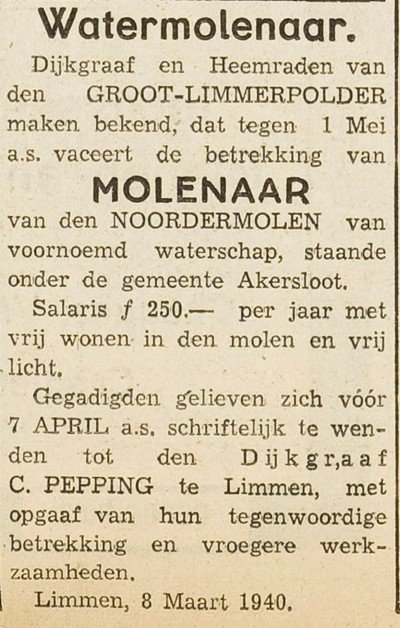
After the war, both the pumping station and the windmill underwent major maintenance. The Act on the Protection of Water Management Structures in Wartime (BWO), enacted in 1952, played a major role in preserving not only the Noordermolen. The government was well aware that windmills could play an important role if our country went to war and the diesel and electric pumping stations failed. The likelihood of that happening was certainly not remote during the Cold War. With funds from the BWO, many windmills were saved and preserved, and the Noordermolen was no exception. It underwent a complete renovation in 1952. It took some effort, but in 1956 the polder received a subsidy of 4,810 guilders, or forty percent of the costs of the aforementioned restoration. Furthermore, in 1957, the province of North Holland issued a regulation whose first article read: “It is forbidden to demolish windmills.” That is why the Noordermolen still stands as a beacon visible from afar in the polder landscape near Akersloot.
These days
In 1990, an electric polder pumping station was installed next to the mill. However, this does not mean that the mill no longer pumps water. In 2010, the mill’s screw pump was found to be in poor condition. Four years later, the Noordermolen received a new one. As a result, the mill can now, when the wind is favorable, achieve a water discharge of seventy to eighty cubic metre minute. This makes the Noordermolen most likely the water-pumping champion among all polder mills in North Holland.
Extra
- Hiking route: Akerslootse Mill near the Alkmaardermeer (Komoot)
- Akersloot Canoe Route (kanoroutes.nl)
- Noordermolen, Akersloot (Dutch Windmill Database)