
Installing, maintaining, or removing a culvert, siphon, or siphon pipe
Drainage pipes, siphons, and siphon pipes ensure that water can flow under or over obstacles, thereby preventing flooding.
- A culvert is a pipe or channel that carries water under roads, paths, or other obstacles.
- A siphon allows water to flow under an obstacle through a closed pipe, so that watercourses with equal water levels can be connected to each other.
- A siphon moves water over an obstacle by means of negative pressure, from a higher to a lower point, often used temporarily.
The installation, maintenance, or removal of these structures must be carried out with care to prevent blockages and problems with water drainage. For this reason, rules set by the water board apply, as laid down in the Water Authority Regulations.
On this page, you can read about the rules and what you need to do to comply with them.
Please note: the project may involve properties owned by the water board. To verify this, please refer to the pages Land Properties and Land Matters.
Rules for your situation
The location and the work you will be performing determine whether one of the following situations applies to you:
- Permit requirement: You need a licence conditions before you can start your work. This applies to work on flood defenses, the protection zone immediately adjacent to them, primary surface water, and waterways managed by the water board, as well as all work on siphons and siphons.
- General rules with information obligation: If no permit is required, general rules may still apply. In that case, you must comply with certain rules in your work and, in most cases, provide the water board with information about your work. This must be done in advance and sometimes also after completion.
- Compliance with the duty of care: There are no general rules that apply to your work. However, you must comply with the applicable duty of care.
Always perform the Permit Check on the Omgevingsloket website to check which situation applies to your work.
Permit check – Step by step
To find out what applies to your work, we always recommend that you do the Permit Check. That way, you will immediately know which rules apply.
Below you will find what is expected of you for each step of the Permit Check and useful tips for the best results.
Beforehand: Keep information about your plans handy
Make sure you have the details of your plans to hand. This information can help you answer the questions correctly.
Step 1: Select location
Select the location of your work. Search by address or zoom in on the map. Then use the "Draw an area on the map" option in the upper left corner of the map to accurately indicate the location.
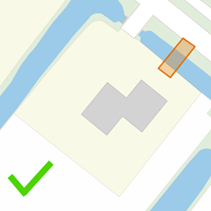
Tip: Accurate drawing of the location ensures a better result from the Permit Check.
Step 2: Selecting activities
Select the work you want to perform. Search for "Duiker" and choose from the following options:
- Constructing or modifying a dam, culvert, or dam with culvert
- Remove dam or culvert
Will you be performing any additional work during your project? If so, please select these activities as well.
Step 3: Answer questions
Go through the questionnaire and answer the questions. Questions that are not relevant to your situation will be omitted. Read the instructions carefully to answer the questions correctly.
Tip 1: Not all explanations are displayed immediately. There is a green i that you can click on to display the explanation.
Tip 2: Has there been a recent change in your area and are you unsure whether the maps shown in the questionnaires are accurate? If so, please contact the water board.
Step 4: Permit check result
You will see an action list. Under the following headings of the action list, you will find what applies to your situation:
- licence : If a license is required
- Reporting and providing information: If general rules with an obligation to provide information apply.
If none of the water board's points are included in the result, then you only need to comply with the duty of care.
Tip: Use the 'Download action list' button to download it. Add it later as an attachment to your permit application or when you provide information. This will help us process your application more efficiently.
Continue: Start application
Use the 'Apply and prepare' button to start your application or provide information right away. The location and the correct forms will then be selected immediately based on the result.
Tip: Even if you do not want to continue with your application immediately, it is useful to start anyway. After completing step 1, your progress will be saved and you can continue later with the correct forms.
General rules
If general rules apply to your situation, you may authorisation your activities without authorisation . However, you must comply with the rules that apply to this activity. These rules are outlined below:
Rules for installing a culvert
When installing a culvert, the following rules apply:
Duty to provide information
You provide us with information about the planned work fifteen working days before installing a culvert.
Within two weeks of completing the work, you will provide us with information about how the work was carried out and any changes to the information provided in the initial report.
Dimensions and capacity of culvert
- The culvert has a maximum length of 15 metre.
- The culvert has an internal diameter of at least 1.2 m.
- The inner bottom of the culvert is laid at 0.8 m below the lowest applicable target level at the site.
- A culvert in a water system that is maintained by boat has:
- A minimum clearance profile with a width of 2.50 metre.
- A minimum clearance height of 1.10 metre to the locally applicable target water level.
- A minimum water depth of 0.90 metre to the locally applicable lowest target level.
- For recreational waterways, the minimum clearance height specified in the environmental regulations or environmental plan shall be observed.
Water level
The culvert is positioned in such a way that the water level and level management remain the same on both sides of the culvert.
Protection of surface water bodies
- The banks on either side of the culvert shall be finished, constructed, and maintained in such a way that they are stable and that subsidence or erosion is prevented.
- The management and maintenance of the culvert and the surface water within 3 metre the culvert shall be carried out by or on behalf of the initiator or the legal successor.
Maintenance of the surface water body
In order to continue to maintain the surface water body properly, the location of the structure must comply with the Maintenance Guidelines of the Water Board Regulations. For more information, see the page: Maintenance of watercourses and engineering structures: what you need to do.
Rules for removing a culvert
When removing a culvert, the following rules apply:
Duty to provide information
You give us fifteen working days' notice of the planned work before removing a culvert.
Protection of surface water bodies
The banks on either side of the culvert shall be finished, constructed, and maintained in such a way that they are stable and that subsidence or erosion is prevented.
Removing culvert
A culvert that loses its function in the water system will be removed in consultation with the water board.
Maintenance of the surface water body
In order to continue to maintain the surface water body properly, the location of the structure must comply with the Maintenance Guidelines of the Water Board Regulations. For more information, see the page: Maintenance of watercourses and engineering structures: what you need to do.
Fulfilling duty of care
The duty of care applies to all activities. The duty of care obliges you to prevent damage to water safety, water quality, and water quantity. If you comply with the permit requirement or the general rules, you will usually also comply with the duty of care. If these rules do not apply, you must assess for yourself whether your activities comply with them. If in doubt, you can request a customized regulation. See the page Duty of care: what you need to know.
Customized prescription
You can request a customized regulation via the Omgevingsloket (Environment Desk) if you deviate from the rules or need help to comply with the duty of care. The customized regulation provides clear guidelines so that you always comply with the duty of care. See the page Customized regulation: what you need to know.
You can request a custom prescription for the following rules:
- Dimensions and capacity of culvert
- Water level
- Protection of surface water bodies
- Maintenance of the surface water body
- Removing culvert
- Duty of care, if you want more clarity on how to fulfill your duty of care
Data and documents
In order to process your application or to comply with the obligation to provide information, we require certain data and documents. Which ones depend on your situation. Below you can read which data and documents you need to provide and how they are requested: as an attachment or via the form.
Tip: Gather all necessary information and documents before you begin your application or provide information.
Informing afterwards
To comply with the information obligation, you must also inform us afterwards. This mainly involves confirming that the work has been carried out. You only need to provide the information again if something has changed. You can use the same form for this.
Always mandatory
The following information and documents are always required:
- Planning of the work (in form or as attachment)
- Site plan, map, or aerial photograph of the location (as an attachment)
Mandatory when installing a culvert
The following documents are required for installing a culvert:
- Construction drawing of the culvert, with the following information:
- Length of the culvert (in meters)
- Internal height or diameter (in meters)
- Internal width or diameter of the culvert (in meters)
- Elevation of the inner bottom of the culvert on the downstream side (meters NAP)
- Elevation of the inner bottom of the structure on the upstream side (meters NAP)
- Shape of the tube
- Around
- Rectangular
Required information and documents when applying for a customized prescription
When requesting a customized prescription, you must provide the following information in addition to the above:
In the application form
- The rule you want to deviate from
- A brief explanation of why you wish to deviate
- The way in which you have involved the community
As an attachment
- Explanation of why you cannot comply with the rule (describe the circumstances)
- Your proposed alternative measure
- How this measure ensures that you comply with the water board's duty of care
Requesting or providing information – Step by step
You can apply for a licence customized regulation and provide information to comply with the information obligation via 'Applications' on the Omgevingsloket (Environment Desk).
Below you will find step-by-step instructions on what is expected of you, along with useful tips on how to do this as well and as completely as possible. If you have continued with the application after the Permit Check, steps 2 and 3 have already been completed for you.
Beforehand: Prepare well
Make sure you are well prepared before you start the application or provide information. Gather all the information and documents you need in advance.
Tip: You can submit a draft request before submitting your application or providing the requested information. This allows you to check whether your application is complete.
Step 1: Create a project
Give your project a name and describe the work you want to carry out. This will help the water board to classify your application correctly.
Tip: Keep the description clear and specific to reduce the likelihood of additional questions.
Step 2: Select location
Select the location of your project by searching by address or zooming in on the map. Then use the "Draw an area on the map" option in the upper left corner to specify the location accurately.
Tip: Zoom in sufficiently to draw the area as accurately as possible.
Step 3: Select activities
Select the forms for the activities required for your application or to provide information. Search for 'Duiker' and choose one of the following options:
- licence application: Installing, maintaining, or removing an access dam – licence application licence Water Board)
- Compliance with information requirements: Installing, maintaining, or removing access dams – Information (Water Board)
- Request for customized regulation: Install, maintain, or remove access dam – Customized regulation (Water Board)
Select all other forms that are required for your project.
Tip: Make sure you have selected all the necessary forms to submit a complete application. This will save you from having to supplement your application later on.
Step 4: Answer questions
Answer all questions as completely as possible. This will enable us to process your application or the information you have provided correctly. It will also prevent additional questions later on during the processing. Questions that are not relevant to your project will be omitted automatically.
Tip: Take your time to fill in the questions carefully. This ensures that only the important attachments will be requested in the next step.
Step 5: Add documents
Attach the requested documents. If a document contains multiple parts, it only needs to be attached once per form. Each form is distinguished by its name, so it is clear which attachment belongs to which application.
Tip: Check that the documents meet the requirements (such as file type and size) of the Omgevingsloket.
Step 6: Fill in your contact details
Please enter your contact details. A phone number and email address are required. Without this information, your request cannot be processed.
Tip: Use contact details where you can be reached quickly in case of any additional questions.
Step 7: Submitting your application
Decide whether you want to submit the application or information immediately or submit a draft request first. A draft request is useful if you want to check that all the information is correct before the process actually starts.
- Step 7a: Select which forms you want to submit, if there are several. It is not mandatory to submit everything at once. For example, you can choose to apply licence a licence first and comply with the information obligation later.
- Step 7b: Choose whether you want to submit a final application or would prefer to submit a draft request first. With a draft request, the application procedure period does not start yet, which gives you time to supplement any missing information.
- Step 7c: In the last section, you answer questions about contact with your neighbours other parties involved in your project. There are also a few questions about any additional information you can provide to clarify the application.
Tip: Opt for a draft request if you are still unsure about the completeness of your application.
Costs and treatment periods
Overview of costs
- Permit application: see the Fees page.
- Customized instructions: see the Fees page.
- processing : free of charge.
Please note: If your application is rejected or if you wish to withdraw your application after a decision has been made, you will still be required to pay these costs.
Treatment periods
- licence customization requirement: processing time of eight weeks. Incomplete applications will be temporarily suspended.
- Duty to provide information: no fixed processing time. You will receive confirmation of receipt and, if necessary, a request for additional information.
Related activities
The installation, maintenance, or removal of a culvert is often accompanied by other activities, such as:
Questions or need help?
Do you have any questions or are you unable to find a solution? Feel free to contact us via the contact form or our Customer Contact centre KCC) on 072 582 8282.
We are happy to help you. Together, we can ensure safe, clean, and sufficient water!