WFD magazine
This page contains only the text of KRW Magazine. The digital version of the magazine can be found via this button:
Structure of online magazine:
- Landing page
- Introduction
- About the Water Framework Directive
- Water quality timeline
- HHNK and the WFD
- How HHNK works to improve water quality
- Specially protected areas within the WFD
- Other measures
- References and contact details
Water Framework Directive & HHNK
On January 1, 2022, the third and final period of the Water Framework Directive (WFD) commenced. This magazine provides insight into this period and the efforts being made by the water board in this regard.
Introduction
Healthy water is essential for the well-being of people, animals, and plants. Many sectors depend on healthy water, such as recreation, food production, industry, and agriculture. The Hollands Noorderkwartier Water Authority is responsible for water quality in North Holland, from the North Sea Canal to Texel. The objectives set by HHNK and the measures implemented to improve water quality are partly determined by the Water Framework Directive (WFD).
On January 1, 2022, the third and final period of the WFD commenced. The purpose of this magazine is to provide insight into this planning period and the efforts HHNK is making in this regard. First, we will briefly discuss water quality over the years. Then we will take a brief look back at the previous WFD periods and explain how the current measures came about. These measures will then be explained in more detail.
Introduction to the Water Framework Directive
In 2000, the WFD came into force in Europe. In the Netherlands, the WFD was translated into the Water Act and then into the Omgevingswet, with the aim of making and keeping water cleaner and healthier. The WFD is based on a river basin approach, and so the Netherlands is divided into four areas: Rhine, Meuse, Scheldt, and Eems. In each area, water boards, Rijkswaterstaat, municipalities, and provinces work together to achieve cleaner water. HHNK is located in the Rhine river basin, which for practical reasons is divided into Rhine-West, Rhine-East, and Rhine-North. HHNK is part of Rhine-West.
The implementation of the WFD is divided into three periods of six years.
- WFD1: 2009–2015;
- WFD2: 2016–2021;
- KRW3: 2022–2027.
Prior to each period, a plan is drawn up to ensure that the water is clean and healthy. For regional waters, the targets are set by the province on the recommendation of the water boards. The national government sets the targets for national waters and natural waters. The type of water determines the extent of intervention. The WFD distinguishes between large waters such as rivers, lakes, canals, and reservoirs, and smaller waters such as ditches. The WFD report focuses exclusively on large waters, but HHNK is committed to ensuring that all waters in its area are clean and healthy.
Water quality timeline
From 1850: Industrialization and connection to the sewer system
When industrialization arrived in the Netherlands, water quality deteriorated significantly. At that time, there was no sewage system and all domestic wastewater was discharged into surface water. During industrialization, factory waste was added to this. The water was black and smelly, and diseases caused a lot of nuisance. At the beginning of the20th century, the construction of sewage systems began. Although everyone is now used to having a sewer system, it took until well into the20th century before all households were connected to it. After the arrival of sewerage, water purification also became possible. These developments had a major positive effect; hygiene improved and the spread of infectious diseases decreased.
1970-present: Protection of water quality in law
After World War II, the intensification of agriculture took off, under the motto: 'No more hunger.' To achieve this, the use of (artificial) fertilizers and new (chemical) crop protection products increased. These substances ended up in surface water. Fertilizers in particular caused algae blooms in the water; the water became green and cloudy and aquatic plants disappeared. To guarantee water quality, the Surface Water Pollution Act was passed in 1970. A permit requirement was introduced for discharges into surface water, and a fertilizer and discharge policy was introduced for farmers. In addition, standards were set for crop protection products. Households and industry were taxed for the use of the sewer system. With the introduction of these rules and regulations, water quality monitoring also began. Despite these measures, the water is still green in some places: blue-green algae and duckweed predominate. This is accompanied by oxygen depletion, which can lead to foul odors and fish mortality.
Future (2027 and beyond): Prevention methods against invisible pollution
An active policy is being pursued to ensure that all waters are clean and healthy by 2027, or remain so, so that flora and fauna appropriate to the water type can develop. The measures drawn up for the WFD are very important in this regard. Nowadays, there is also increasing attention for micro-pollutants in water: drug residues, pesticides, microplastics, hormone-like substances, and new chemical compounds (PFAS). HHNK is working on new techniques to remove these substances from sewage. To gain more insight into this, research is being conducted into the short- and long-term effects. In addition, it is important to prevent these substances from ending up in (waste)water. For example, do not flush unused medication down the toilet and do not leave your waste in nature; what does not end up in the water does not need to be removed from it.
HHNK and the WFD
In 2000, the European Water Framework Directive (WFD) came into force, with the aim of making water clean and healthy. Under the WFD, each EU member state draws up a plan every six years with measures to improve water quality, which is reported to Brussels. Prior to each new period, targets are set based on the most recent insights into the water system. These targets are translated into a package of measures that must be implemented by the end of the period in question. This chapter briefly discusses the past two periods and how the measures for the currentthird WFD period were established.
Past periods and current period
At the start of the first WFD period in December 2009, virtually all water in the HHNK management area met the chemical targets required at that time. This was not the case for the ecological targets: approximately half of the water bodies were rated 'poor' and the other half were rated 'inadequate'. This was in line with the national situation: in 2009, only 0.4% of all water in the Netherlands received a ‘good’ WFD rating. During the first (2009-2015) and second (2015-2021) WFD periods, various measures were implemented that led to an improvement in water quality. These measures focused on, among other things, the management and design of the area, emissions from agriculture, monitoring, research, and innovation.
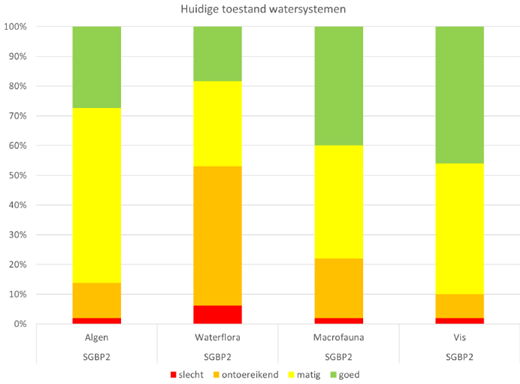
In 2015, the targets for both chemistry and ecology were adjusted. The image below shows the situation at the end of WFD2 with regard to the ecological targets. At that time, there were (local) exceedances for a number of substances, including PAHs, crop protection products, and heavy metals.
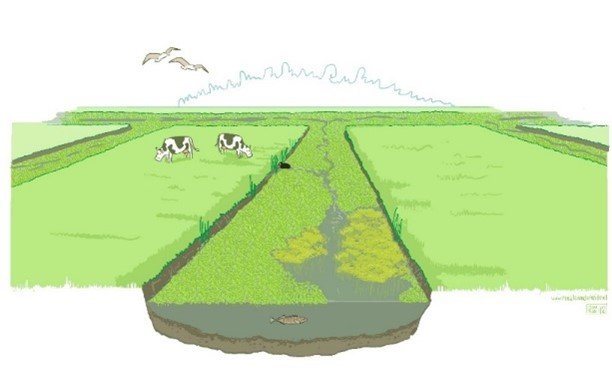
To determine the objectives for the currentthird WFD period, extensive research was conducted to gain a better understanding of how the water system functions: a water system analysis. These water system analyses revealed that the conditions for good water quality were not yet being met in a number of important areas:
- In many channels, polder ditches, and lakes, there was not enough light reaching the bottom for aquatic plants to grow. The absence of aquatic plants resulted in limited diversity of fish and other animals in the water (see: Clear or cloudy).
- The amount of nutrients in the surface water was too high. In many areas, this is mainly caused by background pollution (see: Naturally occurring substances).
- In many places, there were fixed water levels instead of natural water levels.
- In one part of the water, the bottom was too nutrient-rich and the structure too weak for aquatic plants to take root.
- There was insufficient variation in water depth.
- Part of the water was not optimally accessible for migratory fish species.
- In many places, management and maintenance were not aligned with water quality objectives.
- In some places, there were exceedances of chemical substances such as PAHs, heavy metals, and other micropollutants.
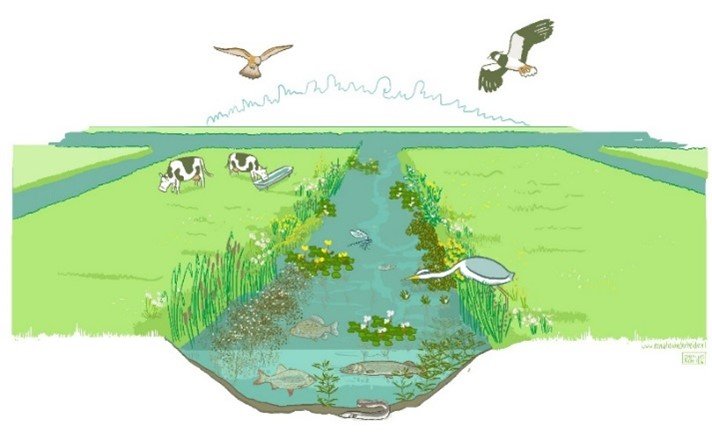
With knowledge of these bottlenecks, it became possible to take targeted and efficient measures. One of the most important conclusions from the study is that there is a high background load in some places in the area (see: Clear or cloudy, Naturally occurring substances). As a result, it is not possible to obtain clear water in many places; the WFD targets have been adjusted accordingly. For waters that do have the potential to become clear, the target is to achieve this during the current WFD period (see figure).
Clear or cloudy
When you think of clean and healthy water, the objective of the WFD, you also think of clear water. Whether water is clear or cloudy is strongly influenced by the presence of nitrogen and phosphorus. These substances can occur naturally in the soil or groundwater, but can also come from outside sources such as fertilizers or emissions. If there is little nitrogen and phosphorus in the water, there will be little algae and/or duckweed in the water. This allows a lot of light to reach the bottom, giving aquatic plants the opportunity to grow. This attracts certain small and larger aquatic animals that thrive in this environment. Fish use these aquatic plants to lay their eggs.
Nitrogen and phosphorus are always present in water to a certain extent, but there can also be an excess of these substances in the water. In this case, more algae will grow in the water. An excess of algae leads to cloudy water. The aquatic plants on the bottom no longer receive light and disappear. This situation is associated with a certain fish population that searches for food at the bottom, such as bream and carp. Due to their foraging behavior, these species contribute to maintaining the cloudy system. Models can be used to calculate the extent to which the amount of nitrogen and phosphorus in the water must be reduced before the water becomes clear again. The tipping point is called the critical load. All lakes, ditches, and rivers have individual characteristics, and the critical load will differ for each body of water.
Naturally occurring substances
The WFD aims to ensure that water is clean and healthy. Measures are therefore being taken to limit the amount of phosphorus and nitrogen in surface water. However, water system analyses show that HHNK has to deal with high natural background pollution in its area. This means that there is a natural abundance of nitrogen and phosphorus, which humans have not influenced (in recent times). The nitrogen and phosphorus present is due, among other things, to the historical influence of the sea on the area and upwelling groundwater (seepage). Phosphorus has also traditionally been present in the deeper layers of the soil. These sources mean that a certain amount of nitrogen and phosphorus is naturally present in the water. This makes it virtually unfeasible in many places in the area to achieve healthy water in accordance with the WFD targets by 2027. The targets for WFD3 at HHNK have therefore been adjusted accordingly.
In the longer term (2050), there is potential to achieve clean and healthy water in some of these areas. This is because there are various developments that will influence future water quality: policy measures in the context of circular agriculture, tackling soil subsidence, and addressing air quality. In the future, clean and healthy water and greater biodiversity may also be possible in these areas.
Monitoring ecological and chemical objectives
To check whether water quality is actually improving, ecological and chemical targets are monitored. For the ecological targets, the water is checked for the presence of algae, aquatic plants, small aquatic animals, and fish. In addition, other characteristics of the water are examined, such as phosphate and nitrogen content, oxygen concentration, salinity, acidity, and transparency. These measurements are reported in the following categories: good, moderate, inadequate, and poor. Appropriate guidelines apply to the various types of water in the Netherlands, which the water must comply with. If a body of water has the status 'good', it meets the ecological WFD standards for clean and healthy water.
The chemical WFD objectives relate to 45 hazardous and toxic substances (priority substances). In addition, there is a list of 77 so-called 'specific pollutants'. Legal standards have been set for all these substances. The monitoring program investigates the presence of all these substances.
How HHNK works to improve water quality
The measures to be implemented in the period 2022-2027 are based on the water system analyses and address the bottlenecks that exist in the water system. For water bodies that have the potential to become clear, the goal is to achieve this in WFD3. In these areas, the implementation of the necessary measures is actively encouraged.
Measures are also being implemented for water bodies with little potential for clear water, but these are being promoted less actively. Measures in these water bodies will mainly lead to local quality improvements and contribute to biodiversity. In the longer term, however, more opportunities may arise in these water systems. In WFD3, we are taking a step in the right direction in these areas.
Each body of water and water type requires a customized approach, but the measures do have some general characteristics. The focus is on optimizing water level management, tackling various nutrient sources, and making management and design more nature-friendly in order to increase the carrying capacity of the system. We will continue to address fish migration bottlenecks and monitor fish migration, and finally there are a few other specific measures.
Under the motto 'by ourselves, together, and through others', HHNK is strongly committed to collaborating with third parties and facilitating their involvement. More than in previous periods, it is essential in this period to enter into and strengthen these collaborations. In recent periods, almost all measures that HHNK could implement independently have been carried out. Most measures that can further improve water quality can only be resolved by collaborating with other parties. That is why active collaboration is sought with other stakeholders such as agriculture, nature organizations, recreation boards, citizens, and other authorities.
Level management
Adjusting water level management aims to retain more water within the area and reduce the supply of water from outside the area. The goal is to reduce the amount of phosphorus and nitrogen in the water and thus improve water quality. Due to the layout and use of our area, water level management has become unnatural over the past centuries. We drain clean rainwater during wet periods to prevent flooding, and during dry periods we bring in water from elsewhere to maintain the water level in the ditches. This allows us to use the land for agriculture or urban development, for example. However, this strict water level is not optimal for water quality and riparian vegetation. These actually benefit from the retention of clean rainwater and a flexible water level. In some places, the inlet water is also rich in nitrogen and phosphate, which puts extra pressure on these areas. However, in many places it is not possible to change the water level management without causing nuisance to agriculture or existing buildings. In a number of areas, there are opportunities to optimize water level management. In most cases, this involves isolating a sub-area from its surroundings, for example for the purpose of nature development. These sub-areas can then be managed with their own flexible (or more flexible) water level management. To determine what is necessary and/or feasible, we will first investigate these opportunities in more detail.
In addition, several other measures related to water level management are being implemented. In a number of areas, water inlet facilities are being automated. This allows us to ensure that water is only let in when the water level drops below a certain level. An additional advantage is that the pumping station then has to pump out water less often.
Management and organization
Management
Maintaining ditches is essential for clean and healthy water. A certain amount of space is needed in the ditch for the supply and drainage of water; this is known as the minimum flow profile. This space is maintained by dredging and mowing ditches. Previously, the rules were the same for every ditch: the ditch had to be completely free of aquatic plants and reeds. In practice, this means that sometimes more space is created in the ditch than is actually necessary for good flow. A different approach to ditch management has created more room for variation in management, as long as this does not impede the minimum flow profile. To make this possible, the rules in the inspection have been relaxed. If there is space available, not all aquatic plants and reeds need to be removed. The presence of plants improves water quality and biodiversity on the banks. Plants also provide natural protection against bank erosion. This project (Room for Growth) involves other parties responsible for maintenance, such as agriculture, nature organizations, recreation boards, and the residents of the management area.
HHNK calculates how much vegetation can remain in the flow profile of the watercourse. In some cases, this means that mowing can be reduced from twice a year to once a year. An interactive map will be available on the website in due course.
Interior design
To increase biodiversity and create habitats for fish and aquatic animals, various existing banks have been given a nature-friendly design. By 2021, approximately 275 kilometre nature-friendly banks (NFBs) will have been created. In KRW3, the ambition is to kilometre another 75 kilometre . NVOs have a gentle slope (gradual transition from land to water) and offer a variety of wet and dry conditions. Existing reed banks can also form an NVO. NECs provide a habitat for all kinds of plants and animals and contribute to increasing biodiversity both on land and in the water. In addition to the official WFD monitoring, many volunteers were deployed in the period 2015-2019 to monitor the biodiversity of the NECs. The results show that NVOs have a measurable positive effect on the local improvement of biodiversity and water quality. That is why other parties are also being encouraged to create NVOs.
In addition to creating new nature-friendly banks, attention is also being paid to the management and maintenance of existing banks. Banks are affected by the dominance of reeds, erosion, or damage caused by water birds, for example. Locally, efforts are also being made to increase the habitat suitability of waterways. This includes changing the water depth for fish to overwinter.
Dredging
In KRW3, we are conducting research into the effectiveness of dredging in a number of areas. Dredging is carried out on a regular basis to restore the ditch to the correct depth. In some places, however, dredging is also carried out to improve water quality. This is not done to deepen the ditch, but to remove the top layer of silt or sludge. This sludge is very nutrient-rich (nitrogen and phosphorus) or has a very fine structure, which makes it difficult for aquatic plants to take root. In addition, this sludge can cause extra nitrogen and phosphate in the surface water. In practice, this quality dredging often proves to be useful, but it does depend on local conditions. It is also important that the source of dredging can be addressed for a lasting positive effect.
Agriculture
Agriculture faces a water challenge due to the high levels of nutrients and crop protection products in surface water. In addition to national policy, farmers are encouraged to take additional, extra-legal measures that improve water quality. We do this through various channels, namely Agricultural Water Management (blue services) and the programme on Soil & Water programme .
Agricultural Water Management
Since 2016, provincial agricultural nature and landscape management has included a subsidy option for agricultural water management measures. Improving water quality is one of the objectives of this scheme. Examples of measures include the creation of buffer strips or flower-rich field margins, ecological ditch cleaning, the use of dredging pumps (peat meadow areas), and the creation of nature-friendly banks. Participating farmers are compensated for their additional costs or loss of income. The agricultural collectives coordinate the implementation of the measures and ensure knowledge development and exchange among the participants.
Working together on Soil & Water
In 2016, HHNK took the initiative to tackle water challenges in North Holland by joining forces with the Province of North Holland, the Rijnland Water Authority (HHRL), the Amstel Gooi en Vecht Water Authority (AGV), LTO-Noord/KAVB, and the four North Holland agricultural collectives in the programme on Soil & Water' programme . This was based on the realization that we all face the challenge of working toward a clean natural environment and that the agricultural sector can make a substantial contribution to this. Through this collaboration, we are promoting water awareness and (subsidy) measures in agricultural business operations that have a positive effect on a resilient, healthy water system and sustainable business practices. To this end, we are using the North Holland Agricultural Portal, which was developed specifically for this purpose:www.landbouwportaalnoordholland.nl.
This portal offers all agricultural businesses in North Holland the same opportunities in terms of knowledge, advice, customized coaching, and subsidies that they can apply for on various water-related topics. To improve water quality, efforts are being made to reduce yard runoff, encourage sustainable soil use, limit the use of crop protection products, and promote more 'green' plot and bank design.
Sewage treatment
Thanks to new purification techniques, sewage treatment plants (STPs) are discharging increasingly cleaner effluent (purified water). The effluent meets the required quality standards and can therefore be discharged into surface water. Research has shown that increasing the treatment efficiency for nitrogen and phosphorus at the Everstekoog WWTP on Texel will have a major positive effect on the local ecology. Texel is in a unique situation: there is no other source of fresh water than tap water from the mainland and rainwater. The effluent from the WWTP is therefore an important source of fresh water. The wastewater treatment plant on Texel currently has a helophyte filter in which the effluent is treated. In a helophyte filter, the water is purified naturally as it flows through a reed bed in marshy soil. The plants and bacteria present purify the water and make it more biologically active. The quality of the effluent from the Everstekoog sewage treatment plant can be improved by installing an additional filter that removes phosphorus and nitrogen from the water. This filter will have a positive effect on water quality on Texel.
In addition to this project, HHNK is doing much more to improve and optimize wastewater treatment. In addition to water quality, the ambitions of circularity and sustainability also play a role in this. The removal of micro-pollutants such as plastics and medicine residues is becoming increasingly important. Together with PWN, HHNK has launched a pilot project (TKI project: Ge(O)zond Water) to remove micro-pollutants at the Wervershoof wastewater treatment plant.
De-phosphatization of inlet water
Dephosphating inlet water reduces the amount of phosphorus in the inlet water. Inlet water is the water that is 'let in' to an area when the water level has dropped below normal. Dephosphating inlet water is used in areas where this inlet water is a major source of phosphorus. It is an important measure to reduce the nutrient content of the water, in addition to measures taken by agriculture, for example. Water intake is necessary during the summer months to maintain the water level in ditches or to flush them out. However, this water also brings in the nutrients nitrogen and phosphorus, especially if the water comes from nutrient-rich areas. The principle of dephosphatization works by binding phosphorus to metals, such as iron. There are various techniques available for dephosphorization of water, such as iron sand filters. We are therefore first conducting research into a technique that is suitable for use on intake water. Our starting point is that the water must not be polluted by chemicals used in dephosphorization. Dephosphorization of water is a relatively expensive measure. That is why we only apply it in areas where the costs of the measure are in proportion to the expected improvement in water quality.
Fish migration
Good ecology is important for clean and healthy water, and this includes fish. That is why special measures are being taken to ensure good fish stocks and promote fish migration. This is not only being pursued under the WFD, but also under other legislation and regulations, such as the Benelux decision on free fish migration and the National and European Eel Management Plans. The HHNK management area is surrounded by the North Sea, the Wadden Sea, the IJsselmeer and Markermeer lakes, and the North Sea Canal, making it ideal for migratory fish such as eel and three-spined stickleback. Eels are born in the Sargasso Sea (north of Cuba) and then migrate to the European mainland to grow up in the fresh water of rivers and polders. Three-spined sticklebacks lay their eggs in fresh water and then migrate to the sea to grow up. Dikes, locks, pumping stations, and weirs sometimes make it almost impossible for fish to pass through.
By 2021, around 65 fish passages will have been constructed or improved within the HHNK management area. Many of these are located on the edges of the management area and connect large polders or drainage areas with the open water; the first step for migrating fish to enter our area. In the period 2022-2027, even more bottlenecks will be resolved. A new feature is the focus on historical water connections, whereby we seek cooperation with spatial developments and recreational routes.
Our goal is to equip pumping stations with fish-safe pumps as much as possible. Examples from the period 2016-2021 include the pumping stations on Texel and the Boezemgemaal C. Mantel pumping station in Schardam. In the current WFD period, we are investigating the fish safety of existing pumping stations and replacing them where necessary and possible.
Specially protected areas within the WFD
Swimming water
The quality of bathing water is very important to water recreationists. Bathing water quality is also important within the WFD. There are 31 official bathing water locations within the HHNK area. During the bathing season, HHNK monitors the water quality at these locations. European and national guidelines have been drawn up to which bathing water must comply. Measurements are taken for the presence of certain bacteria (e.g., the intestinal bacterium E. coli) and blue-green algae. If there are too many of these bacteria or algae in the water, the province may issue a warning or ban swimming. The province communicates the quality of the swimming water to recreational users via information boards and the website www.zwemwater.nl (also available as an app).
In accordance with the division of tasks, HHNK also submits proposals for improvement measures and takes the initiative in this regard. The location manager (municipality, swimming club, or recreation board) is responsible for implementing the improvement measures.
In recent years, a number of specific measures have been taken at various locations in the HHNK area to improve bathing water quality. For example, in Oude Niedorp, at the Skarpet location, a jetty that attracted water birds has been removed. In the Jagersplas, a pump has been installed that pumps up deep, blue-algae-poor water to flush the swimming areas. A similar system is in use at a number of swimming bays in the Geestmerambacht recreation area. Pumps have also been installed in 't Twiske, at the Vennegat and Speelsloot locations, to flush the water and thus shorten the residence time of the water at these locations. An iron sand filter has been installed at Zwaansmeer to remove phosphate from the water that is let in. Fun fact: iron sand is a by-product of drinking water production, which until recently was not used for anything.
Measures will be taken at various swimming locations between 2022 and 2027. In 't Twiske and Geestmerambacht, research will be conducted into further measures to optimize the quality of the water (for swimming). In 't Twiske, this will mainly focus on reducing blue-green algae nuisance. In Stad van de Zon, the measures are aimed at improving the vegetation in the labyrinth on the south side of the area. The aquatic plants provide natural filtration of the water. At other locations with bottlenecks, HHNK will continue to explore possible measures.
Natura 2000
Natura 2000 is a European network of protected nature areas. In these areas, certain plants, animals, and their natural habitats are protected by European legislation. A management plan has been drawn up by the province for all Natura 2000 areas. This plan contains the measures necessary to preserve or restore the protected nature. HHNK also has several Natura 2000 areas within its management area. The objectives of Natura 2000 usually take precedence over the objectives of the WFD, but in general, the two objectives do not conflict with each other. This is partly because most of the objectives for Natura 2000 within the HHNK area apply to land and not to water. However, conflicting interests may arise. For example, an area may be designated as a habitat for a colony of birds; the presence of birds may potentially affect water quality. In this case, the WFD objectives are secondary. In the period 2022-2027, HHNK will conduct research into the possibilities for improving water quality in a number of Natura 2000 areas, such as the Zwanenwater and the Kalverpolder. For the other areas, we are awaiting initiatives from others and will try to include water quality in those plans. This is the case, for example, in Amsterdam Wetlands and the Westzaan polder.
Other measures
In addition to the measures discussed above, several other measures are also being implemented.
Exotic species
Firstly, a policy on exotic species management is being developed. There has been an increase in exotic species within the HHNK area. Exotic species are plant or animal species that do not originally occur here. Some of these species disrupt the ecosystem or cause damage. These are referred to as invasive exotic species. Examples include water crassula, American crayfish, and Japanese knotweed. In order to respond to this more effectively, a policy on exotic species management is being developed. In many cases, this is a national issue, and we are monitoring developments at other water management authorities.
Leaching from former landfills
Secondly, leaching from a number of former landfill sites in the area is being addressed. Before waste was incinerated, it was buried in the ground at so-called landfill sites. These landfill sites were later remediated and the waste was covered, as it were, to ensure that there was no direct contact with the contaminated landfill material. However, elevated concentrations of ammonium have been measured in the surface water (leaching) around a number of former landfill sites. If present in high concentrations, this can have toxic effects on fish, for example. The landfills with a risk of ammonium leaching within the HHNK area have been located. Together with the province, research is being started into possible solutions for two locations. The results of this research will be used to tackle the other locations.
Communication campaign
Finally, non-toxic gardening is encouraged among private individuals in order to reduce the excessive use of crop protection products and other biocides in surface water.
See also:
Want to know more?
Visit our websitewww.hhnk.nl or contact Annette Beems or Jan Willem Huizinga by phone at +31 (0)72 – 582 82 82.
Sources
- M. Fennema: WFD measures and targets for the Hollands Noorderkwartier Water Authority 2022-2027. 2020
- H. van Dam, N. Jaarsma & S. van Dam (2019). Tailored targets 4. System analyses. Herman van Dam, Water and Nature Consultant, Amsterdam. Report 1308-4-1. / Nico Jaarsma, Aquatic Ecology & Photography, Den Hoorn
- All reports from Tailored Goals
- Fact sheets SGBP 2022-2027 Water Quality Portal
- Information Point Living Environment: Water Framework Directive
- Information Point Living Environment: Implementation of the WFD in the Rhine-West Region: working together on water quality
- HHNK monitoring data
- Agricultural portal North Holland
- Netherlands Environmental Assessment Agency: Balance of the living environment 2023
- Province of North Holland: Natura 2000 management plans
- S. van Dam: Dynamic species composition in nature-friendly banks HHNK 2011-2019
- STOWA: Key Ecological Factors
- STOWA: Guidance on WFD targets
- STOWA: References and benchmarks for natural water types for the WFD 2021-2027
Videos about fish migration
Photography and images
- Nico Jaarsma
- Harry Schuitemaker
- Sandra Roodzand
- Alkmaar Regional Archives
- Ronald van der Heide Studio
- Klaas Sjouke de Boer
- Rik Beentjes