Frequently asked questions about the use of granulite in Saskerleidam
Last update: February 11, 2026
The Alkmaarder- en Uitgeestermeer Recreation Authority (RAUM) is currently carrying out a project in the Alkmaardermeer near the Saskerleidam. The project involves creating a sheltered zone on the south side of the Saskerleidam to prevent further erosion of the dam. The sheltered zone will also be designed in an environmentally friendly manner, which will contribute to the ecological water quality of the Alkmaardermeer. Below you will find frequently asked questions and answers about the use of granulite. For more information about the project, visit the RAUM website: Saskerleidam shore and nature development - Projects - Alkmaardermeer and Uitgeestermeer.
What is HHNK's role in the project?
The water board is the licensing authority and supervisor. HHNK has authorisation , subject to additional conditions, for the construction of a dam with a granulite core. HHNK is not the initiator of the project. HHNK is contributing financially because of the boost to ecological water quality.
What is granulite?
Granulite is a fine material that is produced when natural stone is crushed. The natural stone consists of granite from Scotland and metamorphic sandstone from Norway. The natural stone is broken down to serve as an aggregate for asphalt and concrete. Asphalt and concrete require grains of a minimum size, but breaking down the stone also produces finer material as a residual product. The grains for asphalt and concrete are washed with water. This water contains fine material. After separating the water from the fine material, granulite remains.
Although the rock from which the granulite originates is located outside the Netherlands, similar rock types can be found upstream in the basins of the major rivers, particularly the Rhine. Erosion of this similar rock has created sand and clay, which have been deposited in the Netherlands. The granulite is therefore similar in composition to the sand and clay found in the Netherlands.
Why is there so much attention for the application of granulite?
Granulite has previously been used on a large scale elsewhere in the Netherlands to deepen sand extraction pits. Deepening deep sand extraction pits is also a measure to improve ecological water quality. During the deepening of these sand extraction pits, concerns arose about the presence of polyacrylamide and the formation of acrylamide. The use of granulite has received a lot of attention in the national press. A flocculant is used in the separation process to remove the finest particles from the wash water. The flocculant causes the fine particles to clump together and settle more quickly. This flocculant consists of polyacrylamide. The polyacrylamide can potentially break down into acrylamide, which is classified as carcinogenic. In response to all the media attention and concerns, the Ministry of Infrastructure and Water Management commissioned studies. Numerous surface water and groundwater samples were taken at several locations and laboratory analyses were carried out on both polyacrylamide and acrylamide. None of the samples showed polyacrylamide or acrylamide above the detection limits, which are below drinking water standards. Despite the positive results of the research, concerns remain and there is still a lot of media attention for granulite.
What is acrylamide?
Acrylamide is a substance that usually forms when starchy products such as potatoes, grains, and coffee beans are roasted. It is found in foods such as French fries, potato chips, bread, rusks, cookies, toast, breakfast cereals, and coffee. Acrylamide is classified as a substance of very high concern due to its carcinogenic properties. Standards for acrylamide have been set for food products and drinking water from a public health perspective in order to limit human exposure to this substance. Acrylamide dissolves well in water, but it also breaks down quickly into carbon dioxide (CO2) and ammonium (NH4).
Why does HHNK permit the use of granulate?
HHNK initially had the same concerns about granulite and the possible release of acrylamide. This is because the release of acrylamide into surface water is undesirable for water quality. On the other hand, the source of granulate is a clean material in which it is unlikely that other contaminants such as PFAS (poly- and perfluoroalkyl substances) or PAHs (polycyclic aromatic hydrocarbons) are present. In soil that is reused, for example, there is a greater chance that a contaminant will be overlooked. Due to concerns about acrylamide, HHNK has required the applicant to have the granulate tested for the presence of polyacrylamide and acrylamide before it can be used in the Alkmaardermeer. This batch testing showed that the amount of polyacrylamide and acrylamide is so low that it is not measurable. The fact that it has not been analytically demonstrated gives HHNK sufficient certainty that the use of granulate will not lead to contamination of surface water with acrylamide. The granulite for the Saskerleidam is therefore of a quality that can be freely used on land and in surface water.
Can the work continue?
Yes, the customization decision has been issued by HHNK for this purpose. We supervision work. The project is also part of the WFD (Water Framework Directive) targets to be achieved. HHNK therefore also has an interest in ensuring that the material does not leach acrylamide.
Does HHNK measure whether acrylamide is released into the water?
Yes, HHNK supervisors monitor the work and take water samples at various times during the application of the granulate. On October 2, 2025, measurements were taken of the dust cloud that formed after a stormy wind. None of the measurements showed acrylamide above the detection limit or the drinking water standard.
How is the spread of granulite throughout the lake prevented?
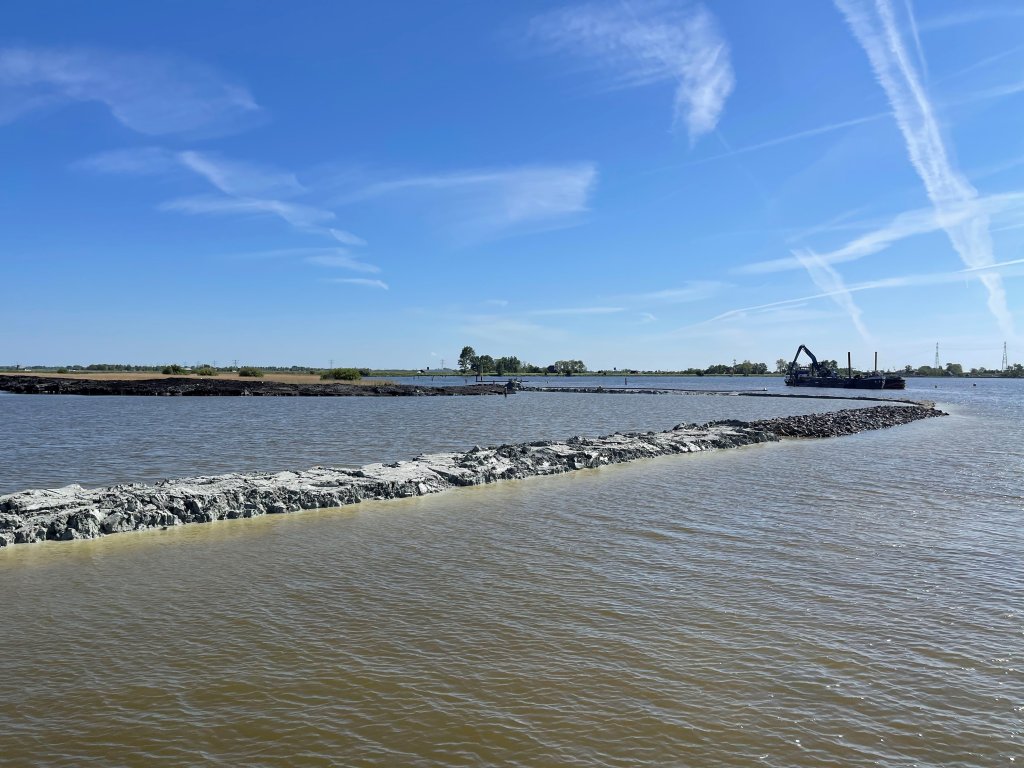
The work involving granulite involves constructing the dam, which has created a dammed bay. The dam will ultimately be covered with clay, geotextile, railway ballast, and riprap, and on the inside, an environmentally friendly bank with turf on the dam. In particular, the clay covering on the granulite core prevents the granulite from coming into direct contact with the surface water.
At the end of September and beginning of October 2025, part of the granulite dam is still uncovered. Why not?
There has been a delay in the supply of clay to cover the remaining granulite core. The current situation is temporary, but temporary measures are being considered.
At the end of September and beginning of October 2025, a dust cloud appeared in the water. Is this granulite, and is it dangerous?
We cannot rule out the possibility that the dust cloud in the water contains granulite. Not all of the granulite applied within the nature development area had been finished with clay by October 2025. Due to the lack of a clay layer, granulite can be stirred up by waves and thus become suspended in the surface water. The dust cloud may also originate from the clay that has been applied. To determine whether acrylamide is present in the dust cloud, HHNK carried out further control measurements on October 2. These measurements also showed no evidence of acrylamide. However, the dust does cause a temporary reduction in sunlight in the surface water. This hinders the development of aquatic species. The dust cloud is mainly located in the dammed area, which will eventually be converted into a nature-friendly environment and will contribute to improving the aquatic ecology.
What is being done to prevent the formation of dust clouds?
The RAUM is responsible for taking measures. The dust cloud is mainly located in the dammed-up section, which will eventually be further deepened and landscaped in an environmentally friendly manner. The dust cloud can also spread to the Alkmaardermeer via an opening between the new dam and the existing Saskerleidam. This is a temporary situation, but the turbidity is undesirable for water quality and aquatic organisms (aquatic flora and fauna). The dam and the nature-friendly zone are expected to be completed in mid-March 2027. To prevent cloudiness until then, the contractor will apply sand from the Alkmaardermeer to the dam that has not yet been definitively completed. The opening to the dammed-off section will also be reduced or temporarily closed. To prevent erosion of the sand that has been brought in, work is currently underway on a design for a riprap breakwater. The breakwater was not included in the original design.
Will the entire expansion of Saskerleidameiland be made of granulite?
No, granulite is only used in the core of the dam on the outside of the dammed section. The section behind the dam is filled with dredged material from the surrounding area, mainly from the Uitgeestermeer and Alkmaardermeer lakes themselves and from the Zaan river. The water board has assessed this dredged material in accordance with the applicable legislation and it complies with the requirements. However, HHNK has additionally required that the areas of the Saskerleidam where the quality class of the dredged material has been assessed as moderate be covered with 0.50 metre of higher quality metre . The application of this top layer is primarily intended to limit the exposure of species in the nature-friendly zone to substances from the dredged material. An additional advantage is that contaminated dredged material is removed from the surface water and covered, which also improves water quality. The surplus dredged material is also put to good use.