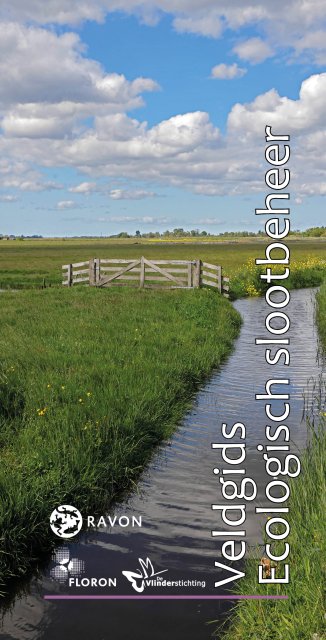
Field guide ecological ditch management free download
Ecological ditch management is in the spotlight. Out in the field, managers are regularly faced with a practical question: what is the best way to manage for plants and animals? To help answer this question, FLORON, RAVON and De Vlinderstichting wrote a handy field guide. HHNK also helped develop and finance the guide.
Well-managed ditches are of great value to many plants and animals. In our increasingly intensively used habitat, this importance is only increasing. The transition from wet to dry provides habitat for marsh plants in which insects find food and shelter. In the water itself, fish, dragonflies and amphibians find a home. Ditches also form connecting routes between farmland, natural areas and urban areas. Periodic maintenance is necessary to prevent ditches from overgrowing. But large-scale and rapid cleaning or dredging causes a lot of disturbance, resulting in a loss of biodiversity.
Pocket-sized practical tips
It can also be done differently. With simple adjustments in management and by working in phases, much biodiversity gain can already be achieved. The guide offers practical tips and is intended for everyone involved in ditch management, from professionals to committed volunteers. It is not a reference work containing everything, but a pocket-sized guide that offers directly applicable advice in many situations.
The publication of the field guide was made possible in part by the Province of North Holland, Amstel, Gooi and Vecht Water Board, Hoogheemraadschap Hollands Noorderkwartier, Hoogheemraadschap van Rijnland and Boerennatuur Rijn, Vecht and Vennen.
HHNK and biodiversity
"HHNK contributes to a rich biodiversity in its management area and a future-proof living environment." This is the core of our vision for biodiversity restoration. We have traditionally had the task of managing, turning and purifying water. In conjunction with these tasks and responsibilities, we can make an important contribution to preserving, enriching and restoring biodiversity in the management area.
Smart mowing for good water management
For the Water Framework Directive (WFD) we are also working to improve ecological water quality. An important measure is to leave part of the vegetation in place during ditch maintenance - if there is room in the profile. This leaves room for aquatic animals and fish to shelter and reproduce. Also, the presence of aquatic plants provides oxygen in the water.
By also conducting ditch management ecologically, an additional contribution is possible to preserve and enhance biodiversity.