
Living and working outside the dykes
Almost the entire Hollands Noorderkwartier region, North Holland above the North Sea Canal, lies below sea level. The primary flood defenses—the dunes and dikes that protect us from the North Sea, the Wadden Sea, the IJsselmeer, and the Markermeer—are therefore of great importance in preventing flooding.
Flooding outside the dikes
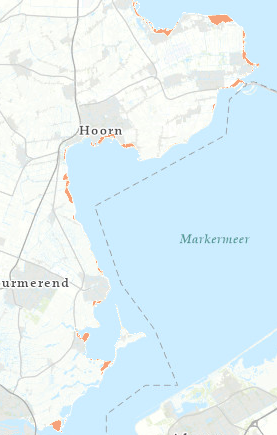
Areas located between the primary flood defenses and the sea or the IJsselmeer or Markermeer lakes are therefore not protected by those dikes. We refer to these as areas outside the dikes. Nevertheless, people live, work, and enjoy recreational activities there. Under normal circumstances, the water does not reach beyond the banks. But under exceptional circumstances, flooding can occur. Climate change has led to more extreme weather conditions, increasing the risk of flooding in the areas outside the dikes, particularly on the shores of the IJsselmeer and Markermeer lakes.
Outside the dikes on the IJsselmeer and Markermeer lakes
The area outside the dikes of the IJsselmeer and Markermeer lakes mainly consists of businesses and recreational homes, but also ordinary houses. During high water, there is a risk of flooding of quays, streets, basements, and sometimes even the ground floor. If you live there, it is wise to take measures.
Slightly more risk
Those who live in areas outside the dikes cannot count on protection from dikes. That is why, as the owner of a home or commercial property, you pay less water board tax. The chance of flooding is still small, but the risk has increased slightly due to climate change. That risk depends mainly on the location of your home or commercial property. In general, the further away from the water and the higher the location, the drier it will be.
Not a statutory duty
Outside the dikes, HHNK has no legal obligation to prevent or combat flooding. The primary dike forms the boundary of the area for which we are responsible. In the area outside the dykes, the municipality assesses the safety situation in the event of flooding, communicates about this, and weighs up the usefulness and necessity of additional protective measures. You are responsible for protecting your property and other possessions.
What can you do yourself?
At What can you do yourself to prevent flooding? you will find various tips for protecting your home and possessions, such as 'installing flood barriers' or 'waterproofing your basement'. There are tips for preventing or limiting flooding and tips for preventing flooding caused by extreme rainfall. The measures often help in both cases.